1684 – The Suspicious Death of Philip Smith
Cotton Mather’s seventh example of witchcraft in New England in his book Magnalia Christi Americana details the death of my ancestor Philip Smith of Hadley Massachusetts in 1684. Philip arrived in the New World as a one year old having been born in England around 1633 to Samuel and Elizabeth Smith, early settlers of Wethersfield CT, and of Hadley MA. Philip Smith married Rebecca Foote the daughter of another early settler and a founder of Wethersfield, Nathaniel Foote.
According to Mather, Philip Smith was murdered by witchcraft. In another unbelievable rendition of events he describes an array of supernatural assaults on the person of Philip Smith:
The Seventh Example: Mr. Philip Smith, aged about fifty years, a son of eminently vertuous parents, a deacon of a church in Hadley, a member of the General Court, a justice in the countrey Court, a select man for the affairs of the town, a lieutenant of the troop, and which crowns all, a man for devotion, sanctity, gravity and all that was honest, exceeding exemplary. Such a man was in the winter of the year 1684, murder’d with an hideous witchcraft, that fill’d all those parts of New England, with astonishment. He was, by his office, concern’d about relieving the indigences of a wretched woman in the town; who being dissatisfy’d at some of his just cares about her, express’d herself unto him in such a manner, that he declar’d himself thenceforward apprehensive of receiving mischief at her hands.
About the beginning of January he began to be very valetudinarious, labouring under pains that seem’d Ischiatick. The standers by could now see in him one ripening apace for another world, and fill’d with grace and joy to an high degree. He shew’d such weanedness from and weariness of the world, that he knew not he said whether he might pray for his continuance here: and such assurance he had of the Divine love unto him that in raptures he would cry out, “Lord stay thy hand it is enongh! it is more than thy frail servant can bear!” But in the midst of these things he still utter’d an hard suspicion that the ill woman who had threatened him had made impressions with inchantments upon him. While he remain’d yet of a sound mind, he very sedately, but very solemnly charg’d his brother to look well after him. Tho’, he said, he now understood himself, yet he knew not how he might be. “But be sure, said he, to have a care of me; for you shall see strange things. There shall be a wonder in Hadley! I shall not be dead, when ’tis thought I am!” He press’d this charge over and over; and afterwards became delirious; upon which he had a speech incessant and voluble, and (as was judg’d) in various languages. He cry’d out not only of pains, but also of pins, tormenting him in several parts of his body; and the attendants found one of them.
In his distresses he exclaim’d much upon the woman aforesaid and others as being seen by him in the room and there was diverse times both in that room and over the whole house a strong smell of something like musk which once particularly so scented an apple roasting at the fire that it forc’d them to throw it away. Some of the young men in the town being out of their wits at the strange calamities thus upon one of their most belov’d neighbours went three or four times to give disturbance unto the woman thus complain’d of: and all the while they were disturbing of her he was at ease, and slept as a weary man: yea, these were the only times that they perceiv’d him to take any sleep in all his illness. Gally pots of medicines, provided for the sick man, were unaccountably empty’d: audible scratchings were made about the bed, when his hands and feet lay wholly still, and were held by others. They beheld fire sometimes on the bed, and when the beholders began to discourse of it, it vanish’d away. Divers people actually felt something often stir in the bed, at a considerable distance from the man; it seem’d as big as a cat, but they could never grasp it. Several trying to lean on the bed’s head tho the sick man lay wholly still, the bed would shake so as to knock their heads uncomfortably. A very strong man could not lift the sick man to make him lie more easily, tho he apply’d his utmost strength unto it; and yet he could go presently and lift a bed-sted and a bed and a man lying on it without any strain to himself at all. Mr Smith dies; the jury that view’d his corpse found a swelling on one breast, his privaties wounded or burn’d, his back full of bruises, and several holes that seem’d made with awls. After the opinion of all had pronounc’d him dead, his countenance continu’d as lively as if he had been alive; his eyes closed as in a slumber, and his nether jaw not falling down. Thus he remain’d from Saturday morning about sun rise, till Sabbath day in the afternoon; when those who took him out of the bed found himstill warm, tho’ the season was as cold as had almost been known in any age: and a New-English winter does not want for cold. On the night following, his countenance was yet fresh as before; but on Monday morning they found the face extreamly tumify’d and discolour’d. It was black and blue, and fresh blood seem’d running down his cheek upon the hairs. Diverse noises were also heard in the room where the corpse lay; as the clattering of chairs and stools, whereof no account could be given. This was the end of so good a man.. [1]
The woman who was blamed for Philip Smith’s supernatural visitations was Mary Webster of Hadley Massachusetts. Her story, heinous treatment and exoneration are given in The History of Hadley.[2]
The most notable witch in Hampshire county was Mary Webster the wife of William Webster of Hadley Her maiden name was Mary Reeve and they were married in 1670 when he was 53 years old and she probably some years younger They became poor and lived many years in a small house in the middle highway into the meadow and were sometimes aided by the town. Mary Webster’s temper which was not the most placid was not improved by poverty and neglect and she used harsh words when offended.[3]
One of the techniques used by the young men of the town to alleviate the supposed enchantment to Philip Smith in Mather’s story above was to physically harass Mary Webster to the point of very nearly killing her:
The disturbing of Mary Webster by the Hadley young men is thus related by Hutchinson. While he Philip Smith lay ill, a number of brisk lads tried an experiment upon the old woman. Having dragged her out of the house, they hung her up until she was near dead, let her down, rolled her sometime in the snow, and at last buried her in it, and there left her; but it happened that she survived, and the melancholy man died.[4]
Mary Webster was tried as a witch at Boston but was acquitted:
At the Assistant’s Court, Sept 4, 1683, Mary Webster, wife to William Webster of Hadley, having been presented for suspicion of witchcraft &c by a grand-jury in Boston on the 22d of May last, and left to further trial, was now called and brought to the bar, and was indicted by the name of Mary Webster &c. (Here the indictment of May 22d is all repeated the warraneage comes in as before). To which indictment she pleaded not guilty, making no exception against any of the jury, leaving herself to be tried by God and the country. The indictment and evidences in the case were read and committed to the jury, and the jury brought in their verdict that they found her – not guilty.[5]
Time marched on and Philip and Rebecca Smith’s great-granddaughter, Mary Smith, married Daniel Shattuck, a Captain for New Hampshire in the Revolutionary War. His father, also named Daniel and also a Captain, built a fort at Hinsdale New Hampshire that was burned down by Indians in 1747 in King George’s War, (see map below). Ultimately, that branch of the family pushed on into New York, then into Ohio and Michigan.

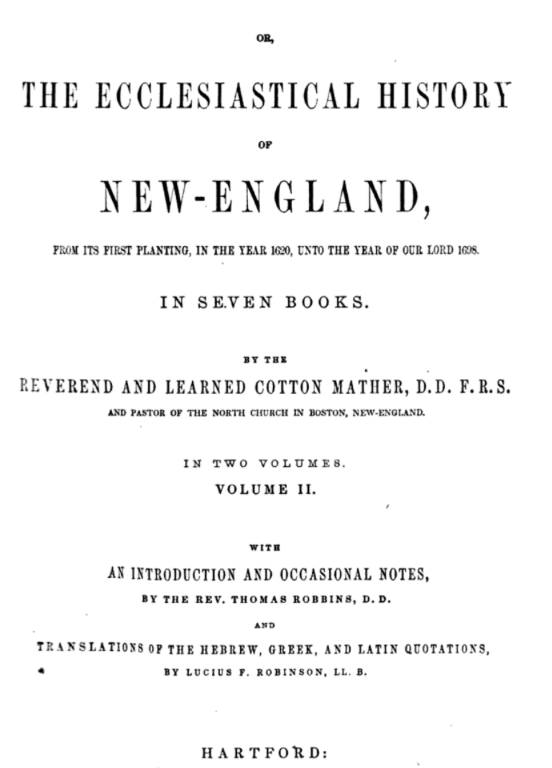
[1] Cotton Mather, D.D. F. R. S., Magnalia Christi Americana; Or, The Ecclesiastical History of New England, v. 2, p. 454-456, London, 1702. Reprint Silus Andrus and Son, Hartford, 1853. https://www.google.com/books/edition/_/iCxKAQAAMAAJ?hl=en&gbpv=1 Last accessed July 2, 2023.
[2] Sylvester Judd, Lucius Manlius Boltwood, History of Hadley, Including the Early History of Hatfield, South Hadley, Amherst and Granby, Massachusetts, p. 236-239, Northampton, Metcalf and Co., 1863. Retrieved from https://www.google.com/books/edition/History_of_Hadley/1q3RY7ns5-8C?hl=en&gbpv=1 Last accessed June 21, 2023.
[3] Id. at p.236.
[4] Id. at p.239.
[5] Id. at p. 238.
 The Boating Genealogists