Pilgrimage to Plymouth – Part Five, Plymouth Massachusetts
“Any people who are indifferent to the noble achievements of remote ancestors are not likely to achieve anything worthy to be remembered by their descendants.” Macauley
Plymouth remembers its history and its noble achievements.
9/21/25 Sunday – We drove to Plymouth and visited the Plimoth Pawtuxet Museum. The museum is a complex of individual sites including an extensive living replica of the Pilgrim village complete with stockade, fort, and Pilgrim houses. The museum complex also includes a Wampanoag home site, and an exhibition hall showcasing early settler crafts and industries.
BACKGROUND
The settlement at Plymouth MA is the first permanent English settlement in New England. It started out as an enterprise of the Virginia Company. The Virginia Company was established in 1606 on the east coast of North America. Its territory spanned east to west one hundred miles inland, and south to north between the 34th and 45th parallels, roughly from Carolina Beach North Carolina up to Pennfield Maine. The area at first was all called Virginia.
The first Virginia Company colony settled in Southern Virginia around Jamestown, and was composed of knights, gentlemen, merchants and adventurers from London. The second Virginia Company colony settled in Plymouth in what was called Northern Virginia and was later named New England.
“Aboute this time also they had heard, both by Mr. Weston and others, ye sundrie Honorable Lords had obtained a large grante from ye king, for ye more northerly parts of that countrie, derived out of ye Virginia patente, and wholy secluded from their Govermente, and to be called by another name, viz. New-England.” [1]
English families living in Holland that had earlier fled England because of their differing religious beliefs, were recruited to join the Northern Virginia colony:
“To that purpose, it was referred to their considerations how necessary it was that means might be used to draw into those enterprises some of those families that had retired themselves into Holland for scruple of conscience, giving them such freedom and liberty as might stand with their likings.” [2]
It is hard to imagine the hardships endured by the Pilgrims on that 65 day Atlantic voyage, each person sharing very limited space with 101 other passengers, their livestock and cargo. My ancestors Thomas Rogers, a signer of the Mayflower Compact, and his son Joseph endured that 65 day trip.[3] Pursuing freedom to follow their religious beliefs they left civilization in September 1620 and disembarked at the shore of the American wilderness in November.
PLYMOUTH ROCK
It was not smooth sailing. Halfway across the ocean they had ferocious weather,
“In sundrie of these stormes the winds were so feirce, & ye seas so high, as they could not beare a knote of saile, but were forced to hull, for diverce days togither… But to omite other things, (that I may be breefe,) after longe beating at sea they fell with that land which is called Cape Cod” [4]
This is what 48 year old Thomas Rogers, seventeen year old Joseph Rogers and the other passengers saw on their arrival to Cape Cod:
“Being thus passed ye vast ocean, and a sea of troubles before in their preparation (as may be remembred by ye which wente before), they had now no freinds to wellcome them, nor inns to entertaine or refresh their weatherbeaten bodys, no houses or much less townes to repaire too, to seeke for succoure. It is recorded in scripture as a mercie to ye apostle & his shipwraked company, that the barbarians shewed them no smale kindnes in refreshing them, but these savage barbarians, when they mette with them (as after will appeare) were readier to fill their sides full of arrows then otherwise. And for ye season it was winter, and they that know ye winters of that cuntrie know them to be sharp & violent, & subjecte to cruell & feirce stormes, deangerous to travill to known places, much more to serch an unknown coast. Besids, what could they see but a hidious and desolate wildernes, full of wild beasts & willd men? And what multituds ther might be of them they knew not. Nethier could they, as it were, goe up to ye tope of Pisgah, to view from this willdernes a more goodly cuntrie to feed their hops; for which way soever they turnd their eyes (save upward to ye heavens) they could have litle solace or content in respecte of any outward. objects. For summer being done, all things stand upon them with a wetherbeaten face; and ye whole countrie, full of woods & thickets, represented a wild & savage hew. If they looked behind them, ther was ye mighty ocean which they had passed, and was now as a maine barr & goulfe to seperate them from all ye civill parts of ye world.” [5]
THE MUSEUM COMPLEX
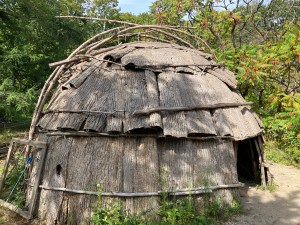
The museum exhibits immerse the visitor in the early era of Plymouth settlement. The museum has an outdoor Wampanoag exhibit including a long house, several smaller structures, dugout canoe, cooking pit and guides that are engaging and knowledgeable about the culture of the tribe. The crafts museum sometimes has working artisans making crafts of the time. After looking at the craftworks on display we visited the Pilgrim village.
REPLICA WAMPANOAG STRUCTURE
THE VILLAGE
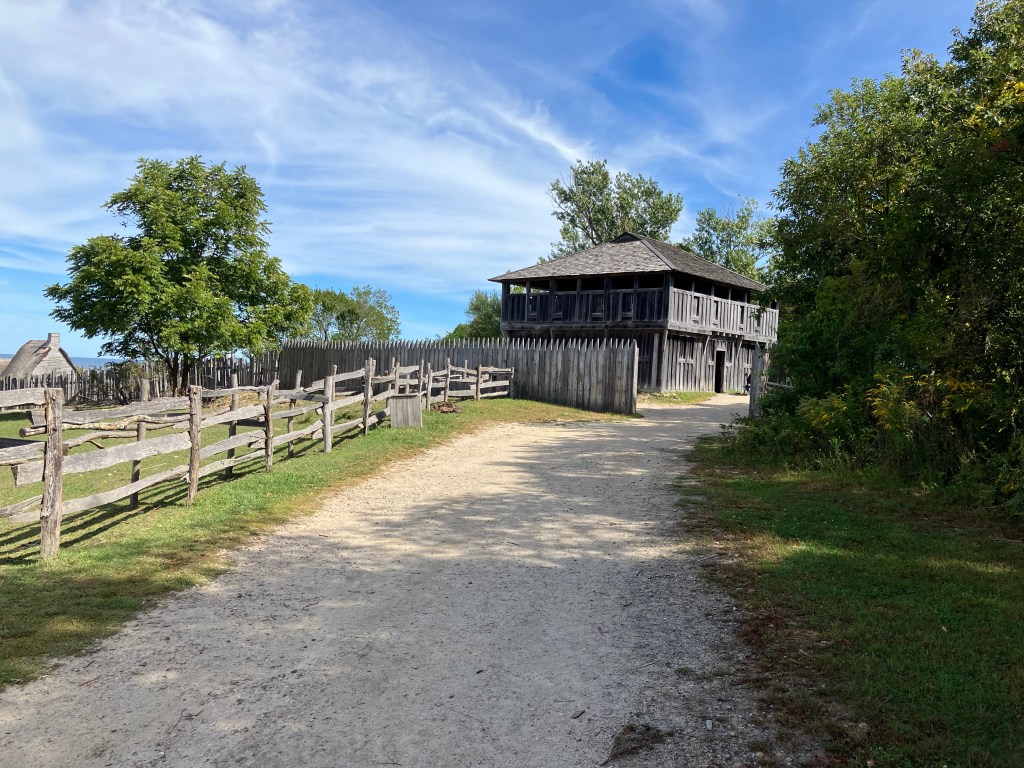
The settlement is a stockaded village consisting of many houses built to replicate what the houses would have looked like as the early Plymouth settlement matured. Each house has a garden and the settlement has a well-armed blockhouse at its entrance. The blockhouse is built of heavy timbers. The two floor blockhouse has cannons on the second level. The first floor has sets of chain mail. According to the historian at the blockhouse some of families brought the chain mail with them to America, probably passed down in their families over time.
PATH TO PLIMOTH VILLAGE
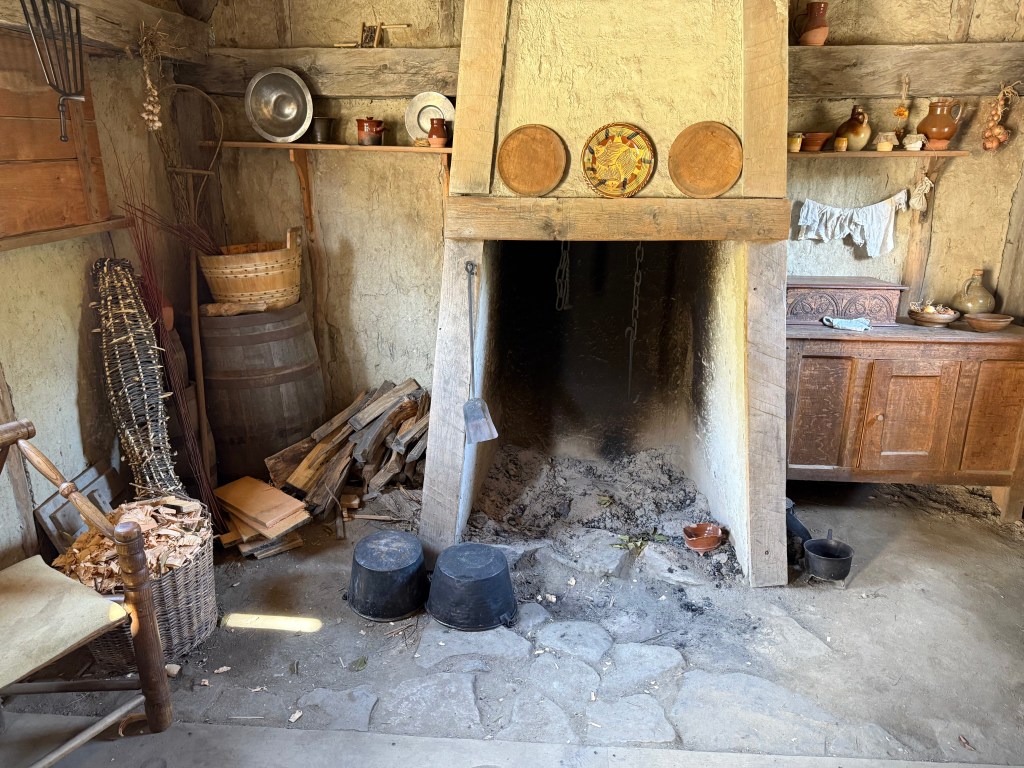
Knowledgeable, engaging guides are found throughout the village, and impersonate specific Pilgrim inhabitants in dress, duties and old English accents. The houses are sided in short pieces of weathered clapboard. House interiors have fireplaces, some enclosed with a chimney and others open to the room. Roofs are covered in thatch. Each house has gardens and some have livestock also.
THE EARLY SETTLER EXPERIENCE
Before the town was built there was nothing but woods. Joseph Rogers was 17 years old in 1620 and he would have lived in a settlement like this. Thomas Rogers did not survive the first winter, but his son Joseph did survive. Joseph would have assisted in constructing houses like these.
Thomas died before the end of March 1621 following the landing at Plymouth. Scurvy and cold weather on arrival weakened most of the passengers and contributed to their approximate 50% death rate that first winter.[6][7]
“…the discommodiousness of the harbor did much hinder us, for we could neither go to, nor come from the shore, but at high water, which was much to our hinderance and hurt, for oftentimes they waded to the middle of the thigh, and oft to the knees, to go and come from land; some did it necessarily, and some for their own pleasure, but it brought to the most, if not to all, coughs and colds, the weather proving suddenly cold and stormy, which afterward turned to the scurvy, whereof many dyed.”[8]
Thomas, Joseph and the other survivors faced a harsh winter with no shelter other than the boat they arrived in and what they could construct themselves. They and the others needed food, shelter and luck to survive. In spite of the winter weather days were spent exploring for a suitable settlement location.
Many of the Indians in the area had perished from disease three years before Thomas, Joseph and the others arrived. Other than small skirmishes, the settlers were able to explore without being attacked by large numbers of hostiles. Plague had cleared out most of the potential opposition to their landing. On their explorations they found an Indian village that had been ravaged by disease:
“They found this place to be 40 miles from hence, ye soyle good, & ye people not many, being dead & abundantly wasted in ye late great mortalitie which fell in all these parts aboute three years before ye coming of ye English, wherin thousands of them dyed, they not being able to burie one another; there sculls and bones were found in many places lying still above ground, where their houses & dwellings had been; a very sad spectackle to behould.” [9]
The Pilgrim’s good fortune included unexpected assistance from Squanto, a native who had been to England and knew the English language:
“Squanto continued with them, and was their interpreter, and was a spetiall instrument sent of God for their good beyond their expectation. He directed them how to set their corne, where to take fish, and to procure other commodities, and was also their pilot to bring them to unknowne places for their profit, and never left them till he died.” [10]
Although the Pilgrims did not meet with much resistance from the local tribe, their sister settlement around Jamestown in the south was not as fortunate. A boat from the South Virginia colony brought them much needed supplies, and bad tidings.
“This boat which came from ye eastward brought them a letter from a stranger, of whose name they had never heard before, being a captaine of a ship come ther a fishing. This leter was as followeth. Being thus inscribed:
To all his good freinds at Plimoth, these, &c.
Freinds, cuntrimen, & neighbours: I salute you, and wish you all health and hapines in ye Lord. I make bould with these few lines to trouble you, because unless I were unhumane, I can doe no less. Bad news doth spread it selfe too farr; yet I will so farr informe you that my selfe, with many good freinds in ye south-collonie of Virginia, have received shuch a blow, that 400 persons large will not make good our losses. Therfore I doe intreat you (allthough not knowing you) that ye old rule which I learned when I went to schoole, may be sufflcente. That is, Hapie is he whom other mens harmes doth make to beware. And now againe and againe, wishing all those yet willingly would serve ye Lord, all health and haippines in this world, and everlasting peace in ye world to come. And so I rest,
That letter refers to the 1622 massive Indian attack that killed over 347 English settlers around the Jamestown settlement. About a quarter to a third of the English population there was killed.
“It was on March 22, 1622 that the great catastrophe struck Virginia in the form of the well planned and carefully executed massacre by the Indians under the crafty leadership of Opechancanough, successor to Powhatan. Although the consequences were not enough to threaten the survival of the Colony, they were deeply serious. At least a fourth, if not a third, of all residents lay dead at the end of a single day.” [12]
On hearing about the Indian massacre of the settlers around Jamestown the Pilgrims quickly built a fort for protection. Joseph Rogers, now 20 years old, very probably assisted in that construction:
“This somer they builte a fort with good timber, both strong & comly, which was of good defence, made with a flate roofe & batllments, on which their ordnance were mounted, and where they kepte constante watch, espetially in time of danger. It served them allso for a meeting house, and was fitted accordingly for that use. It was a great worke for them in this weaknes and time of wants; but ye danger of ye time required it, and both ye continuall rumors of ye fears from ye Indeans hear, espetially ye Narigansets, and also ye hearing of that great massacre in Virginia, made all hands willing to despatch ye same.” [13]
INTERIOR OF REPLICA PILGRIM HOUSE
Economics played a large part in the survival of the colony. The Pilgrims needed supplies from Europe and some extra food from the Indians. Dependent on others for food and materials, trade was required in order to survive. Starting in 1628 the use of wampum as money facilitated trade with the Indians. Wampum are beads laboriously made from different colored seashells. Each color had a different worth based on its rarity. Wampum was manufactured by some Indian tribes and was used as currency to trade for items like food and fur. The Pilgrims bought wampum from the Dutch for that purpose and profited:
“But that which turned most to their profite, in time, was an entrance into the trade of Wampampeake; for they now bought aboute 50H worth of it of them; and they tould them how vendable it was at their forte Orania; and did perswade them they would find it so at Kenebeck; and so it came to pass in time. though at first it stuck, & it was 2 years before they could put of this small quantity, till ye inland people knew of it; and afterwards they could scarce ever gett enough for them, for many years together.” [14]
THE MILL
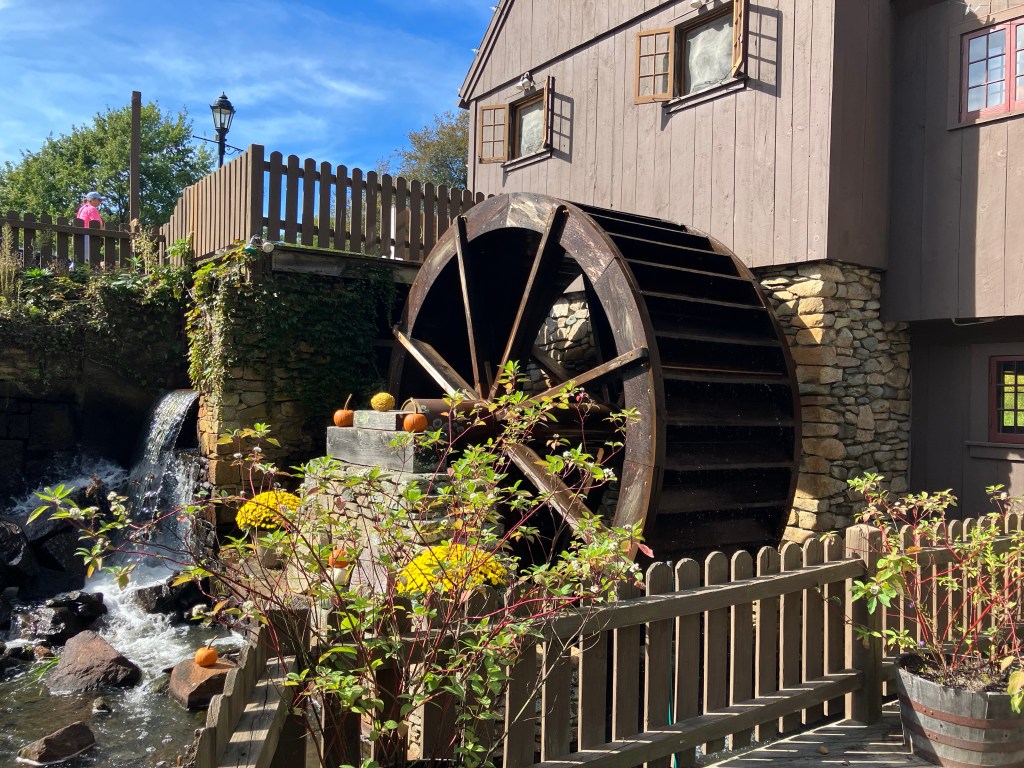
A short drive from the museum complex we toured a water-powered grain grinding mill, an example of early engineering ingenuity. The mill is a replica of the original mill built in 1636 that that stood on the same spot.[15]
The massive water-wheel powered mechanism is constructed of wood, with two 54 inch diameter parallel grinding stones each about a foot thick. The stones are set horizontally, ingeniously separated by moving the heavy timbers supporting the stones to different depths apart, facilitating course or fine milling as they are moved closer together.
GRIST MILL WATER WHEEL
PLYMOUTH ROCK
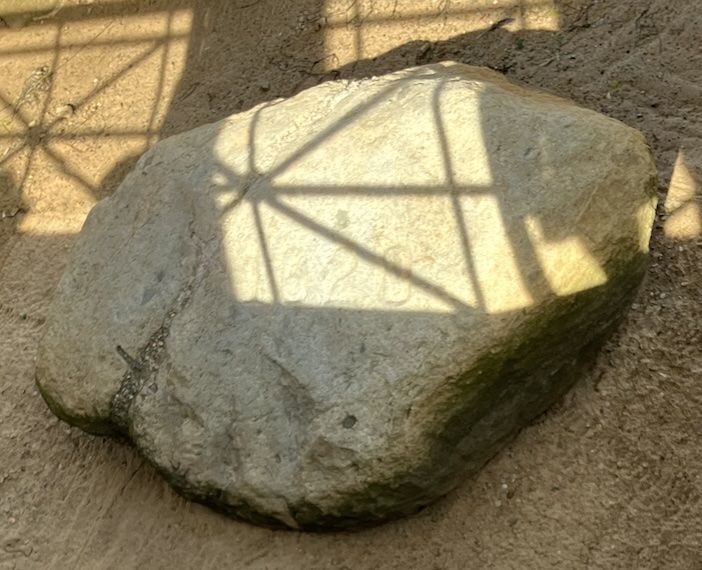
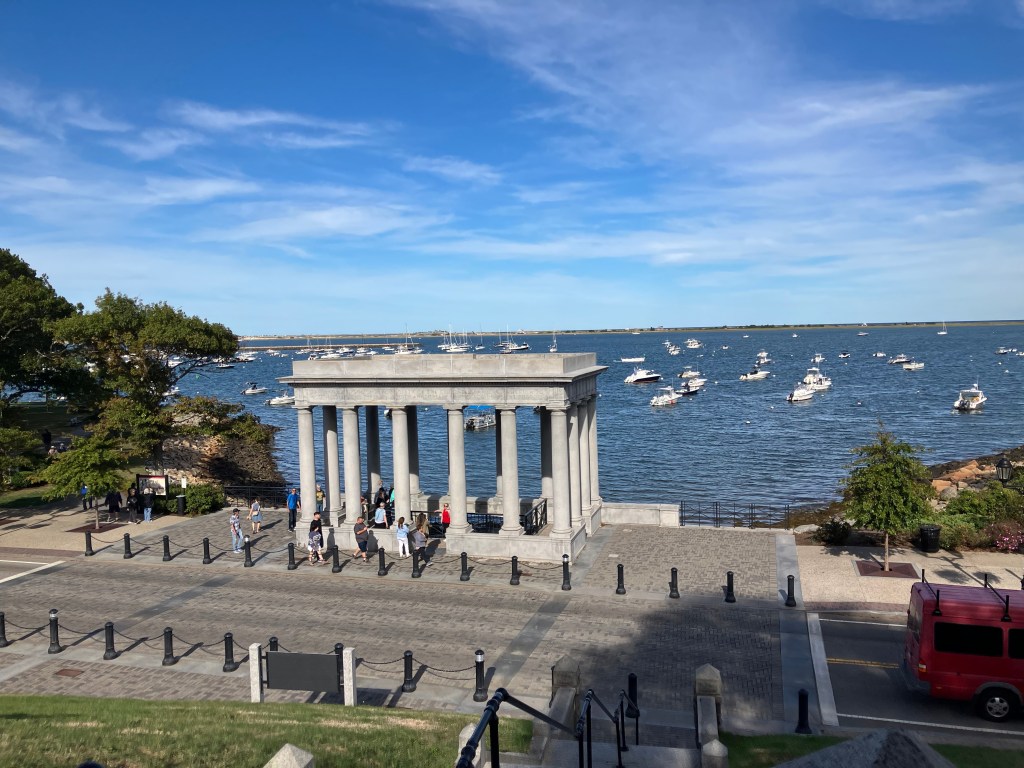
Plymouth Rock is a short walk from the mill. The rock is engraved with the year 1620 and is enclosed in an iron bar grating under a large granite colonnaded memorial. The rock is about eight feet below street level, at the level of the ocean shore, and is said to mark the spot where the Pilgrims first stepped ashore into that bleak wilderness in 1620.
PLYMOUTH ROCK CANOPY
THE MAYFLOWER 2
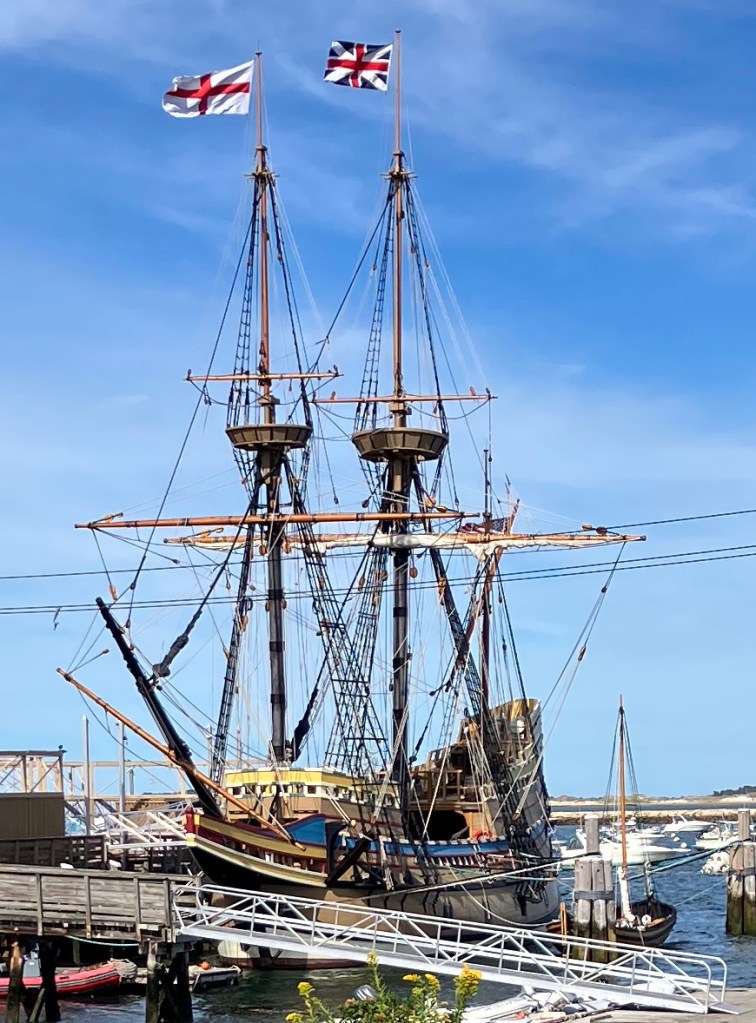
Next we toured the nearby Mayflower II, a replica of the original Mayflower. The ship was small for 102 passengers. It had a large capstan for loading and unloading. There was no wheel to control the rudder. Instead the tiller that controlled the rudder was operated on the level where the passengers also lived. The ship’s navigator on the top deck would order course changes to the tillerman below. The bottom of the ship carried ballast and cargo. Historically correct, the standing rigging is dark colored and running rigging is a lighter color.
MAYFLOWER II IN PLYMOUTH HARBOR
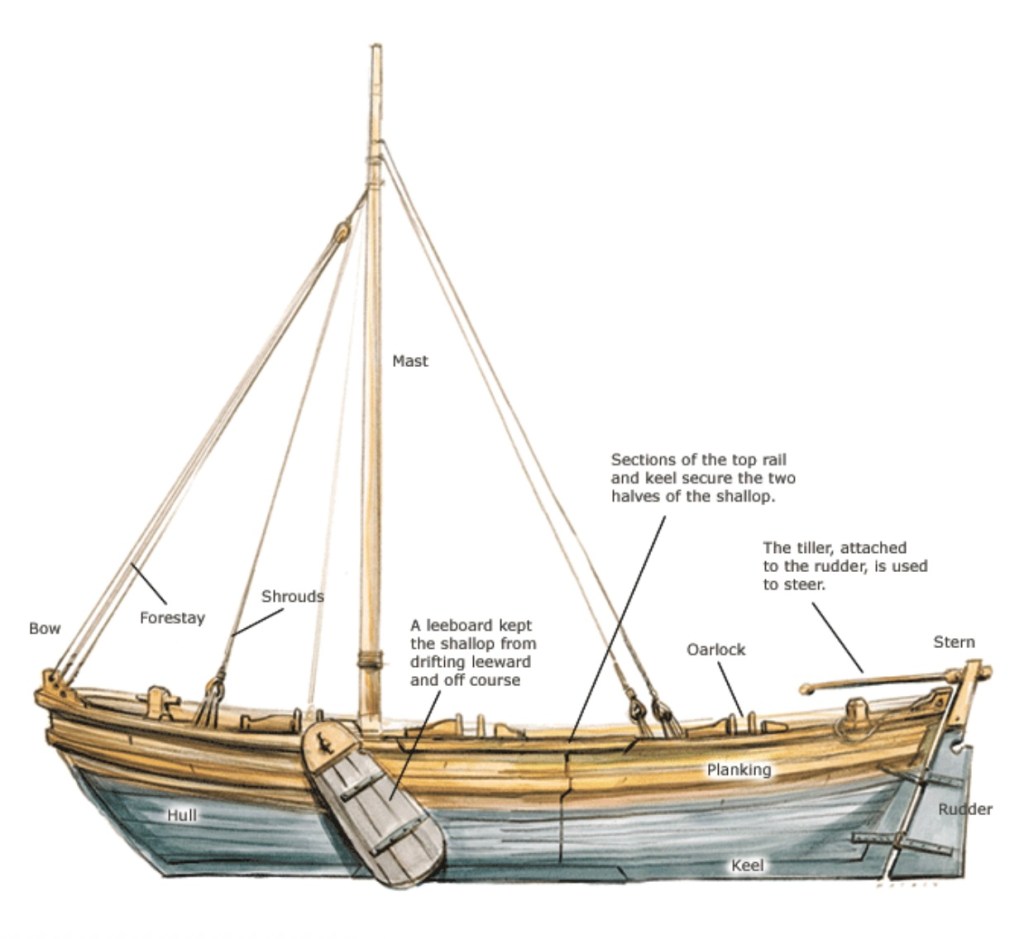
The ships shallop floated next to the Mayflower II, but would have been stored disassembled in the ship during the journey to America, then reassembled on arrival. The shallop was an integral piece of the Pilgrims equipment and was used to explore the area after landing. Probably about 33 feet long and 10 feet wide at its beam it was a large sailboat, also capable of being rowed. Its draft of 2 foot to 3.5 foot allowed it to enter and explore shallows, rivers and bays.
Below is a drawing of what an early 1600’s shallop would have looked like. Note the oarlocks and drop-down keelboard, (one for each side), well suited for navigating shallows and open water. [16]
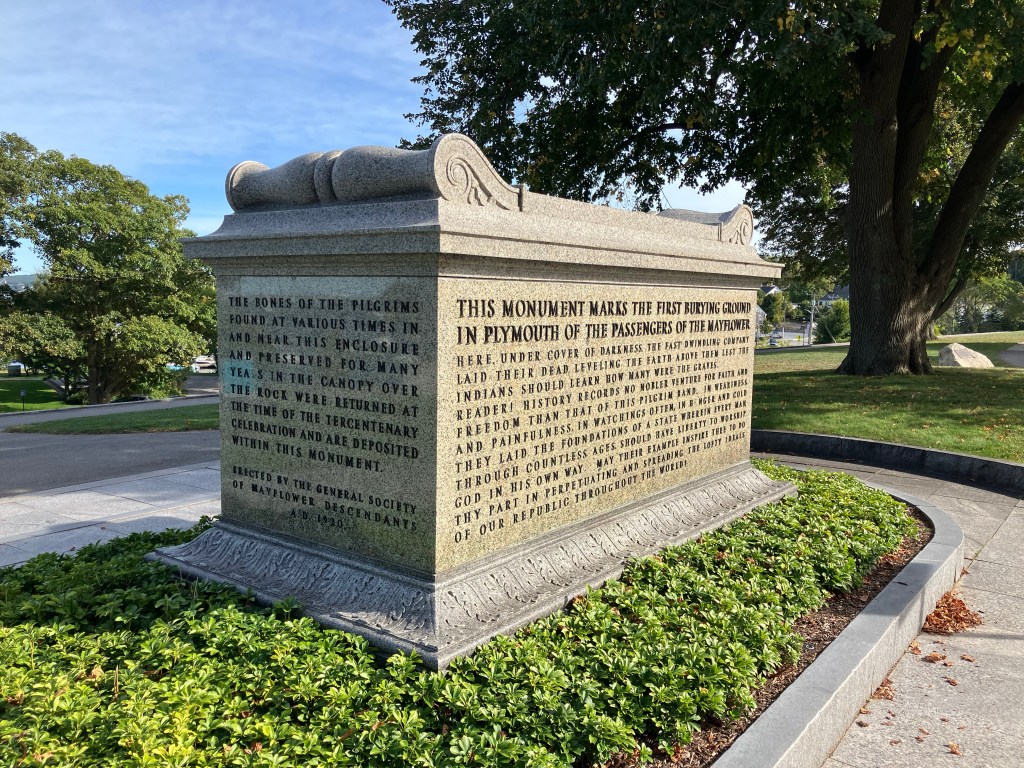
After touring the ship we climbed the nearby stairs at Cole’s Hill and saw the mass tomb of the Mayflower passengers who died the first winter. The monument looks out over the harbor and the Plymouth Rock Canopy. The tomb is high on the hill and contains the remains of many of the people that did not survive that first winter. As the hill eroded over time some graves became exposed and so remains were entombed together there.
COLE’S HILL MONUMENT
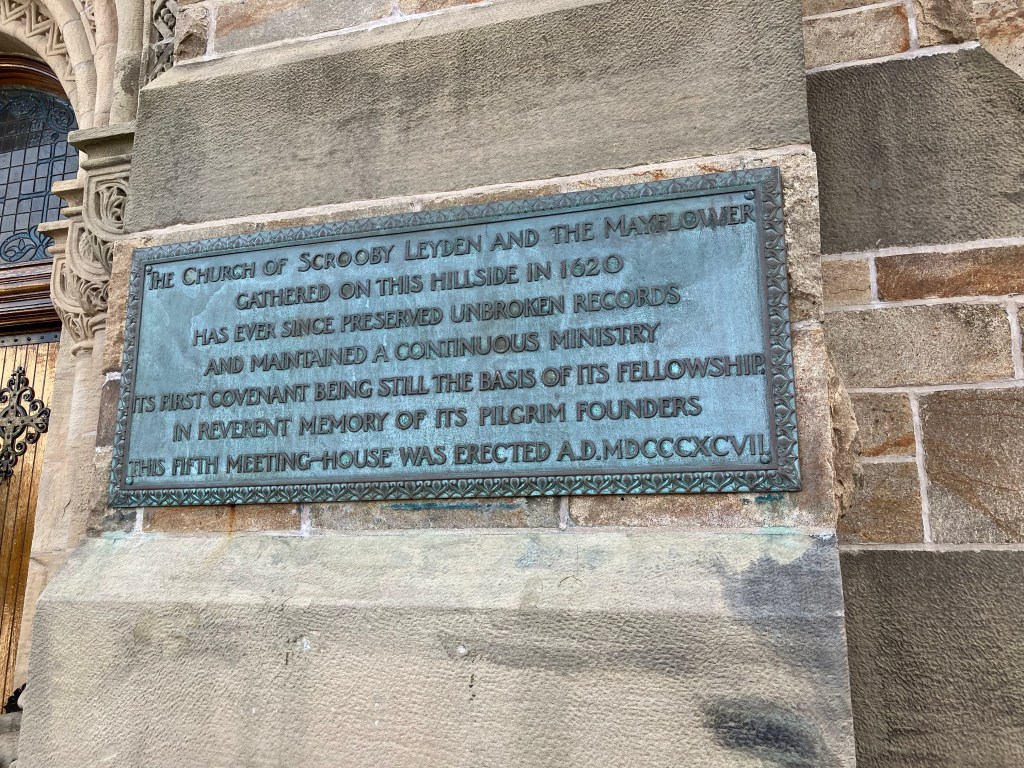
PLYMOUTH FIRST PARISH CHURCH PLAQUE
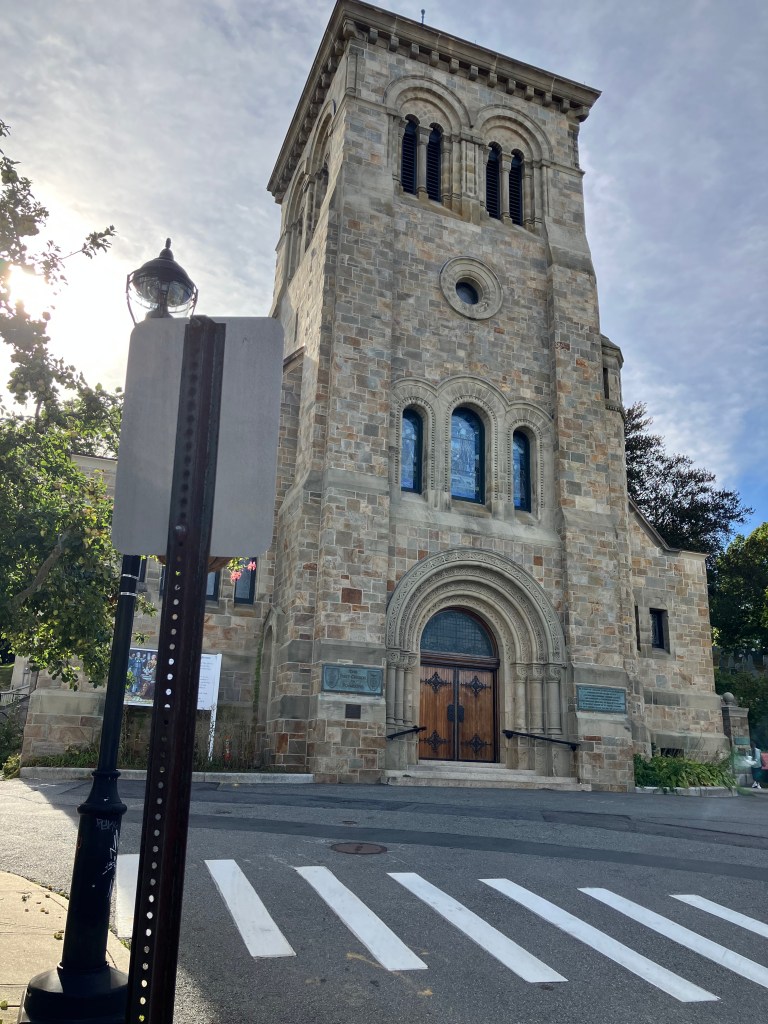
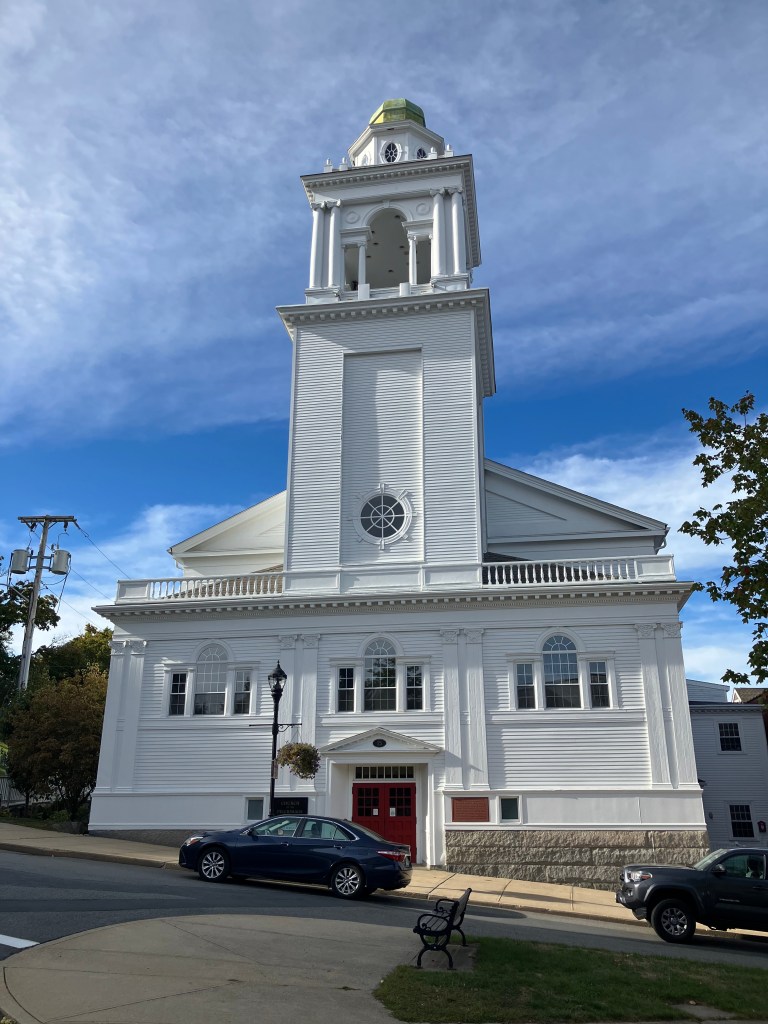
A short way uphill from the tomb are two large churches built at the same location as the first Pilgrim church. Walking through the nearby residential area we saw many houses that are two hundred years old or older.
PLYMOUTH FIRST PARISH CHURCH
Across the street from the churches is an ancient courthouse dating to the 1700’s where John Adams, the second U.S President, appeared as an attorney in pre-Revolutionary times. Small exhibits showcased native artifacts, and an old water pump fire-engine that was pulled by hand by 18 firemen.
PLYMOUTH CHURCH OF THE PILGRIMAGE
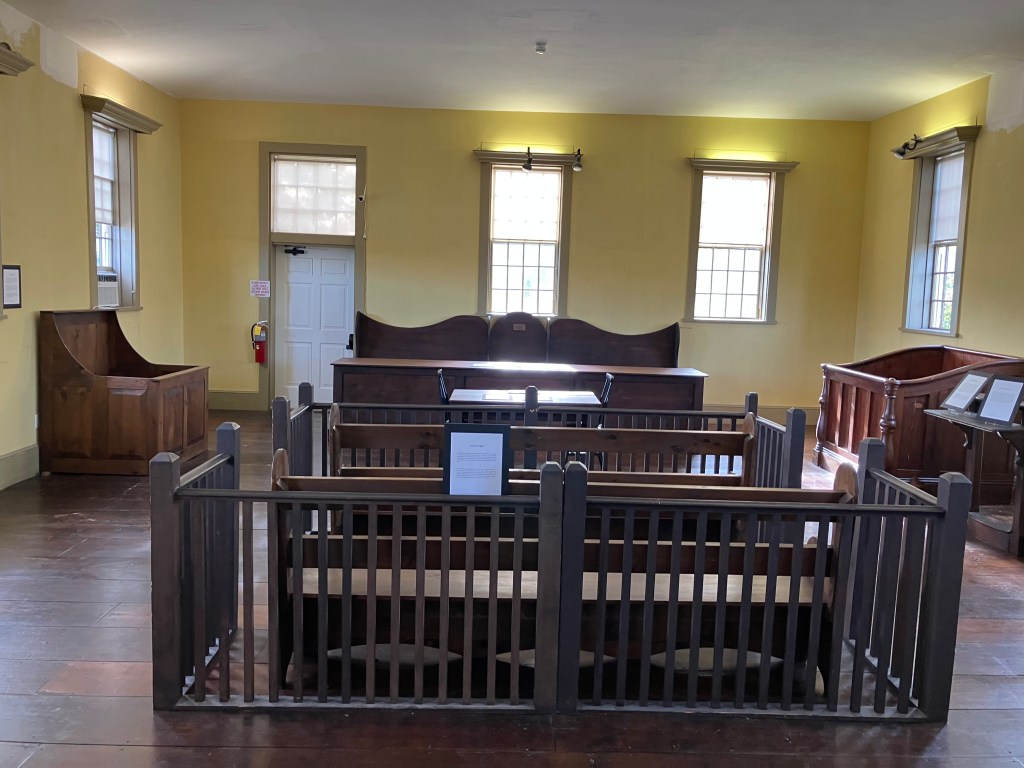
After touring the courtroom on the second level, the courthouse guide suggested that we also visit the nearby Monument to the Forefathers.
OLD PLYMOUTH COURTROOM
THE MONUMENT TO THE FOREFATHERS
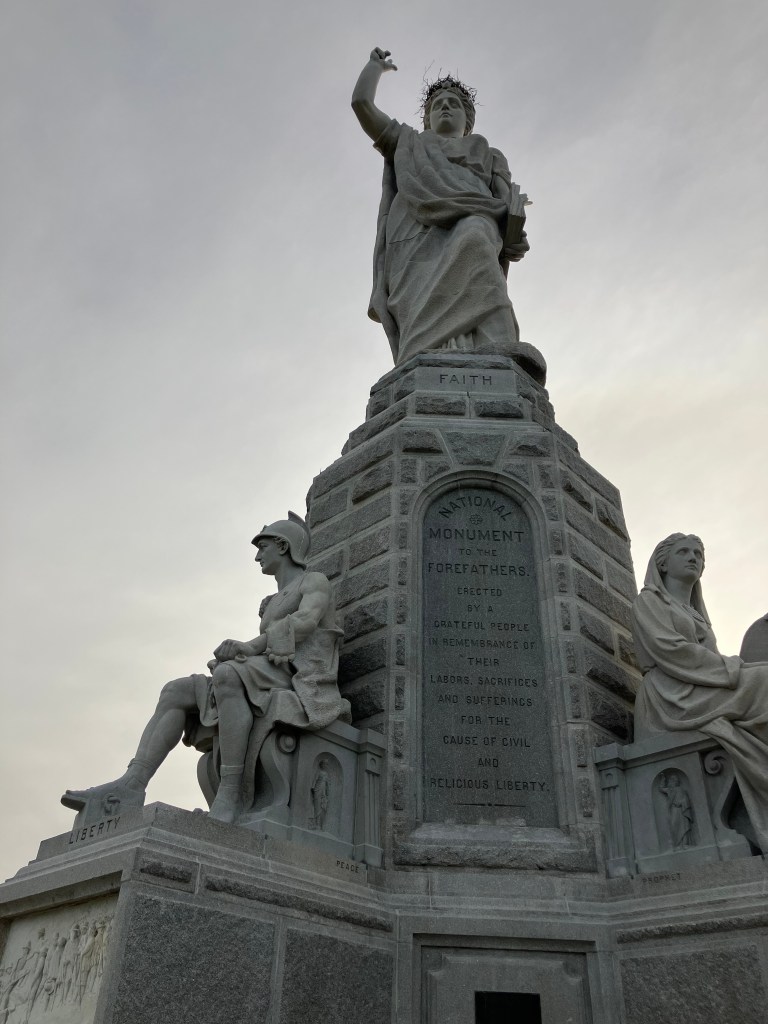
The Monument to the Forefathers is 81 feet tall and is inscribed with the names of the Mayflower passengers and with the inspirational ideals that they held dear.[18] The statue on the monument is named for Faith and is temporarily crowned with an osprey nest that appears as if it is an intended part of the sculpture, a victors wreath placed there by nature.
NATIONAL MONUMENT TO THE FOREFATHERS
The monument’s inscribed panels include a famous quote by William Bradford,
“Thus out of small beginings greater things have been produced by his hand yet made all things of nothing, and gives being to all things that are; and as one small candle may light a thousand, so ye light here kindled hath shone to many, yea in some sort to our whole nation; let ye glorious name of Jehova have all ye praise.”[19]
A SHORT INTROSPECTION
A trip to Plymouth is worth the effort. Like hot embers being stoked in a fire, or the religious fervor burning in the eyes of a people willing to risk everything for their beliefs, Plymouth is stoked in history. Walking in the path of ancestors here that accomplished so much against all odds is overwhelming.
What could now sustaine them but ye spirite of God & his grace? May not & ought not the children of these fathers rightly say: Our fathers were Englishmen which came over this great ocean, and were ready to perish in this wilderness but they cried unto the Lord, and he heard their voyce, and looked on their adversitie…Let them therfore praise ye Lord, because he is good, & his mercies endure forever. [20]
 The Boating Genealogists