9/20 – Saturday – North Kingston Rhode Island is home to Richard Smith’s Castle. The Swamp Fight Monument is located in nearby West Kingston. The two places are inextricably linked together in the history of King Philip’s War. First we visited the site of the monument.
BACKGROUND
The Great Swamp Fight Monument memorializes the battle that took place early in King Philip’s War 350 years ago. The war was an attempt by King Philip’s tribe, the once friendly Wampanoags and allied tribes, to eradicate all of New England‘s colonists.
The Great Swamp Fight was an attack on a Narragansett Indian fort by colonists and their native allies, the Mohegan and Pequot tribes. The attack was in reprisal for Indian attacks at Swansea, Mendon, Brookfield, Deerfield, Northfield, Bloody Brook and Springfield that killed over 170 settlers.[1] It was near the site of the monument that Nathaniel Seeley, a captain of his troops, was shot by the traitor Teft during the ferocious battle.
Nathaniel died of his wounds days after the battle.[2] Nathaniel Seeley is buried in the mass grave of 40 soldiers who died in the battle.[3] The grave is located on the grounds of Richard Smith’s Castle.
Teft, a turncoat during the battle, was drawn and quartered for shooting Nathaniel and several other colonial soldiers. He was executed on the grounds of Richard Smith’s Castle.
“The Englishman that was taken had his doom yesterday, to be hanged and quartered; which was done effectually.” – (Internal quotations omitted). [4]
THE GREAT SWAMP FIGHT MONUMENT
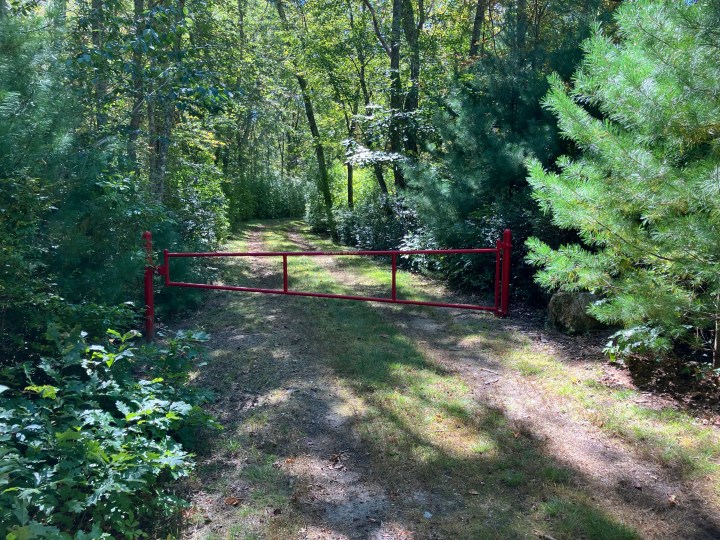
The monument and related land were given to the local Narragansett Indian tribe in 2021.[5] After a short drive down the road to the Memorial we came to a metal barricade. Beyond the barricade is a wide well-mown grassy path. After walking down the path beyond the barricade, and uncertain of the distance to the memorial, we decided to go back to our car for our bikes.

Part way down the path toward the memorial we came to a similar barricade as the first one that we encountered and we went around it also. Next we came to a round trail encircling a small swampy treed area. We followed the trail around the swampy area and slightly past that, approximately .93 miles from the first barricade, we located the memorial. We took photos on every side of the monument.
Four large granite blocks encircle the obelisk, each inscribed with the names of the four colonies involved in King Philips War, Connecticut, Rhode Island, Massachusetts, and Plymouth. We noted stones, and offerings of various types, placed on the base of the monolith. I’ve seen similar offerings left at Fallen Timbers where an Indian Chief named Turkey Foot fell.

The granite blocks and monolith are untouched except for the mementos at the base of the monolith. The slate marker placed here many years ago is weathered and badly damaged, slightly defaced with initials, chipped and basically unreadable in its entirety. The marker’s inscription in full originally stated:
ATTACKED
WITHIN THEIR FORT UPON THIS ISLAND
THE NARRAGANSETT INDIANS MADE THEIR LAST STAND
IN KING PHILIP’S WAR AND WERE CRUSHED BY THE UNITED FORCES OF THE MASSACHUSETTS
CONNECTICUT
AND PLYMOUTH COLONIES
IN THE
“GREAT SWAMP FIGHT”
SUNDAY 19 DECEMBER 1675
THIS RECORD WAS PLACED BY THE RHODE ISLAND SOCIETY
OF COLONIAL WARS
1906 [6]

RICHARD SMITH’S CASTLE
We traced the path back to our car and drove 15 minutes to nearby Richard Smiths Castle. By today’s standards it is a large house. By colonial standards it was a mansion. The location was a trading post, a place for trading goods with the Indians. The first Smith house was burned down during King Philips War. It was the staging point for an army of over 1000 colonial troops that were preparing for the battle, and it was a rendezvous point after the battle. Burned down in revenge after the battle it was rebuilt in 1678 right after the conclusion of King Philips War.

The Castle is located in a region of Rhode Island named after a brook called Cocumscussoc. After signing in for the tour of the castle we were directed to the site of the marker for the mass grave. After paying our respects at the grave we toured the building with a guide.

As noted above, the first Richard Smith house was burned in King Philips war. The existing house was constructed immediately after the war ended in 1678. It was built on the same spot as the first house by Richard Smith Jr. who inherited his father’s lands in 1666. Its interior construction is made of heavy timbers, some salvaged from the first house. The floor has wide planks, some over a foot wide. The support beams show working by adze. The downstairs fireplace is massive.
The current house was saved from demolition in the 1940’s and is owned by the Cocumscussoc Association. The house is open for guided tours and is well worth a visit.
Richard Smith Sr. settled at the location around the year 1640. Smith was the first Englishman to settle in the area. He died in 1666 owning a vast amount of land.[8] His house was located on the Pequot Path, an ancient trail. The current address is 55 Richard Smith Drive, North Kingstown, RI.
Richard Smith was a contemporary and friend of Roger Williams who settled nearby seven or eight years after Smith. Smith bought out Williams’ nearby trading post in 1651. Both men were important figures in the development of colonial Rhode Island. The Smith family English coat of arms is incorporated into the North Kingston city seal.
“Mr. Smith, it seems from the account of Roger Williams… was from Gloucestershire in England, of a respectable family; and on coming to this country, settled down at Taunton. He remained there but a few years; as Taunton was first planted in 1637 …
Within a few years after this, trading houses were built in Narragansett, by Roger Williams and a Wilcox. Roger Williams built within seven or eight years after Smith, and not far from him; but after keeping it a few years, he, in 1651, sold out to Smith his trading house, his two big guns, and a small island for goats, which had been lent him by the Sachems…
The Smiths, afterwards made additional purchases of the Indians. March 8, 1656, Coginiquant leased them for sixty years, the land South of their dwelling house…June 8, 1659. The same Sachem leased to them for one thousand years, a tract…Also, at the same time he leased them the meadows at Sawgoge, and Paquinapaquoge, and a neck of land, lying East from the house on the other side of the cove…Smith’s was the first purchase, but there was not much done towards the settlement of the country by the whites, until the Pettiquamscut purchase, some time after.” [9]
The monument site and castle grounds are quiet and peaceful now. There is no hint of the carnage that once surrounded both places. Nathaniel Seeley was my 10th great-grandfather and Richard Smith is an ancestor of the Scott family. It is both fascinating and illuminating to visit these locations where an ancestor engaged in such a well documented and important conflict in a pivotal era in the nation’s development.
[1] Bruce A. Wright, Discover Your Roots! Rediscovering the Heroes of the Indian Wars of New England and New Netherlands 1636 – 1698, p. 44-52, by the author, Amazon, 2020.
[2] Bruce A. Wright, The Fighting Seeleys, 2024. https://theboatinggenealogists.com/2024/12/03/the-fighting-seeleys/
[3] Bruce A. Wright, Discover Your Roots! Rediscovering the Heroes of the Indian Wars of New England and New Netherlands 1636 – 1698, p. 50, by the author, Amazon, 2020.
[4] J. Hammond Trumbull, A. M., Public Records of the Colony of Connecticut, v.2, p. 401, Brown, Hartford, 1852. https://babel.hathitrust.org/cgi/pt?id=wu.89096129630&seq=411
[5] Alex Nunes, Site of ‘Great Swamp Massacre’ Returned to Narragansett Indian Tribe, Rhode Island PBS, 2021. https://thepublicsradio.org/article/site-of-great-swamp-massacre-returned-to-narragansett-indian-tribe/#:~:text=The%20Great%20Swamp%20Massacre%20occurred,the%20Rhode%20Island%20Historical%20Society.
[6] The Rhode Island Society of Colonial Wars, The Ceremony and Oration On the Occasion of the Unveiling of the Monument Commemorating The Great Swamp Fight December 19, 1675, Merrymount Press, Boston, 1906. https://babel.hathitrust.org/cgi/pt?id=hvd.hx4g3n&seq=76
[7] The Rhode Island Society of Colonial Wars, The Ceremony and Oration On the Occasion of the Unveiling of the Monument Commemorating The Great Swamp Fight December 19, 1675, Merrymount Press, Boston, 1906. https://babel.hathitrust.org/cgi/pt?id=hvd.hx4g3n&seq=76
[8] Elisha R. Potter, Jr. Early History of Narragansett, p. 166-167, Marshall, Providence, 1835. https://archive.org/details/earlyhistoryofna00pott_0/page/n182/mode/1up
[9] Elisha R. Potter, Jr. Early History of Narragansett, p. 32, Marshall, Providence, 1835. https://archive.org/details/earlyhistoryofna00pott_0/page/n50/mode/1up
Copyright Bruce A. Wright, Esq. 2025 ©
 The Boating Genealogists