Home of Reverend John Lothropp
9/19 Friday – We visited the home of John Lothropp (1584-1653), an 11th great-grandfather of mine. He was a minister, a religious exile, and a founder of Barnstable Massachusetts. He arrived in New England in September 1634. The name Lothropp is also spelled Lothrop and Lathrop, etc. He left England shortly after his release from London’s notorious Clink Prison where he was imprisoned in 1632. At age 48 he was jailed there for over two years for preaching contrary to English religious orthodoxy. While he was in prison his wife died. After her death his destitute children begged church authorities for his release which was mercifully granted. Shortly after his release he and his family left England for America.
John Lothropp Arrested While Preaching
“Their private sanctuary, a room in the house of Mr. Humphrey Barnet, a brewer’s clerk in Black Friars, is suddenly invaded. Tomlinson and his ruffian band, with a show of power above their resistance, sieze forty-two of their number, allowing only eighteen of them to escape, and make that 22d day of April, 1632, forever memorable to those suffering Christians, by handing them over in fetters to the executioners of a law which was made for godly men to break. In the old Clink prison, in Newgate, and in the Gatehouse, all made for felons, these men, “of whom the world was not worthy,” lingered for months. In the spring of 1634, all but Mr. Lothropp were released on bail…His wife fell sick, of which sickness she died. He procured liberty of the bishop to visit his wife before her death, and commended her to God by prayer, who soon gave up the ghost. At his return to prison, his poor children, being many, repaired to the bishop at Lambeth, and made known unto him their miserable condition, by reason of their good father’s being continued in close durance, who commiserated their condition so far as to grant him liberty, who soon after came over into New England.” [1]
Sailing to Freedom in America
At age 50 John Lothropp and his family sailed to freedom in America on the ship the Griffen with about 100 passengers. The famous Anne Hutchinson, also very much a rebel to the religious orthodoxy of the time, and her family were also among the passengers on the ship.[2] Here again, as noted in several of my prior articles, are family members in close contact with her:
“We can readily believe that Mistress Anne Hutchinson furnished enough excitement aboard the Griffin when she engaged the Reverend John Lothrop and the Reverend Zachariah Symmes in theological bouts…” [3]
Arrival Among His Friends
Arriving in America in September 1634 John Lothropp and his family settled first in Scituate Massachusetts which at the time had “at least nine settlers” houses.[4]
“The Reverend John Lothrop, who had been vicar at Edgerton, Kent, and later in London conducting Separatist services surreptitiously, was undoubtedly the inspiration for the emigration of a large contingent from the Weald of Kent who settled in Scituate.”[5]
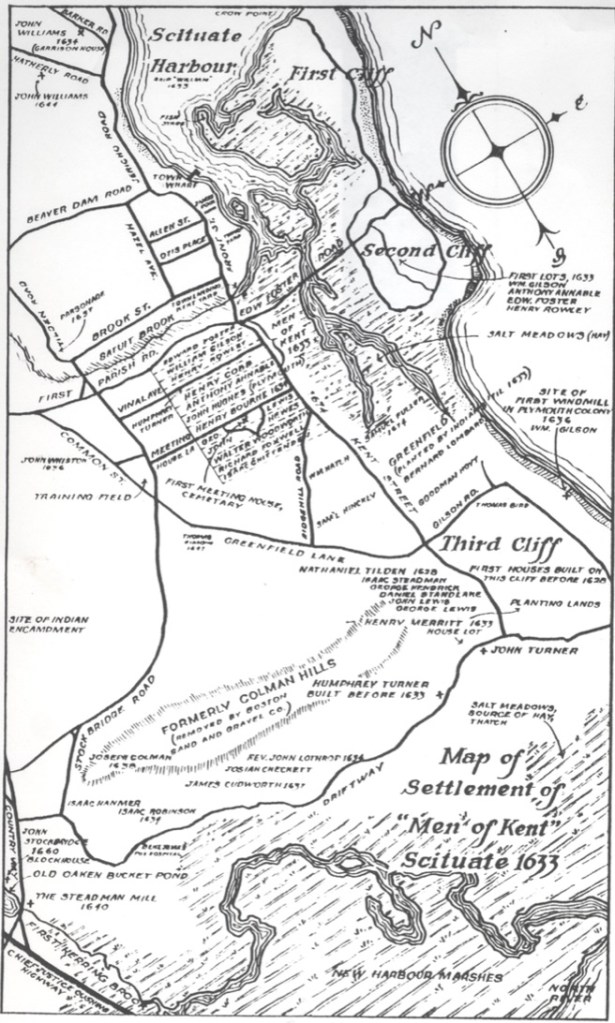
One of the settlers at Scituate was my great-grandfather Anthony Annabel who had arrived on the Anne in 1623.[6] The Scituate community was nicknamed, “men of Kent”, on a map of old Scituate, below.[7] Anthony Annabel, Henry Ewell who married Anthony Annabel’s daughter Sarah, and other Scituate settlers followed John Lothropp on his next move and together they founded Barnstable. [8]
The Move to Barnstable
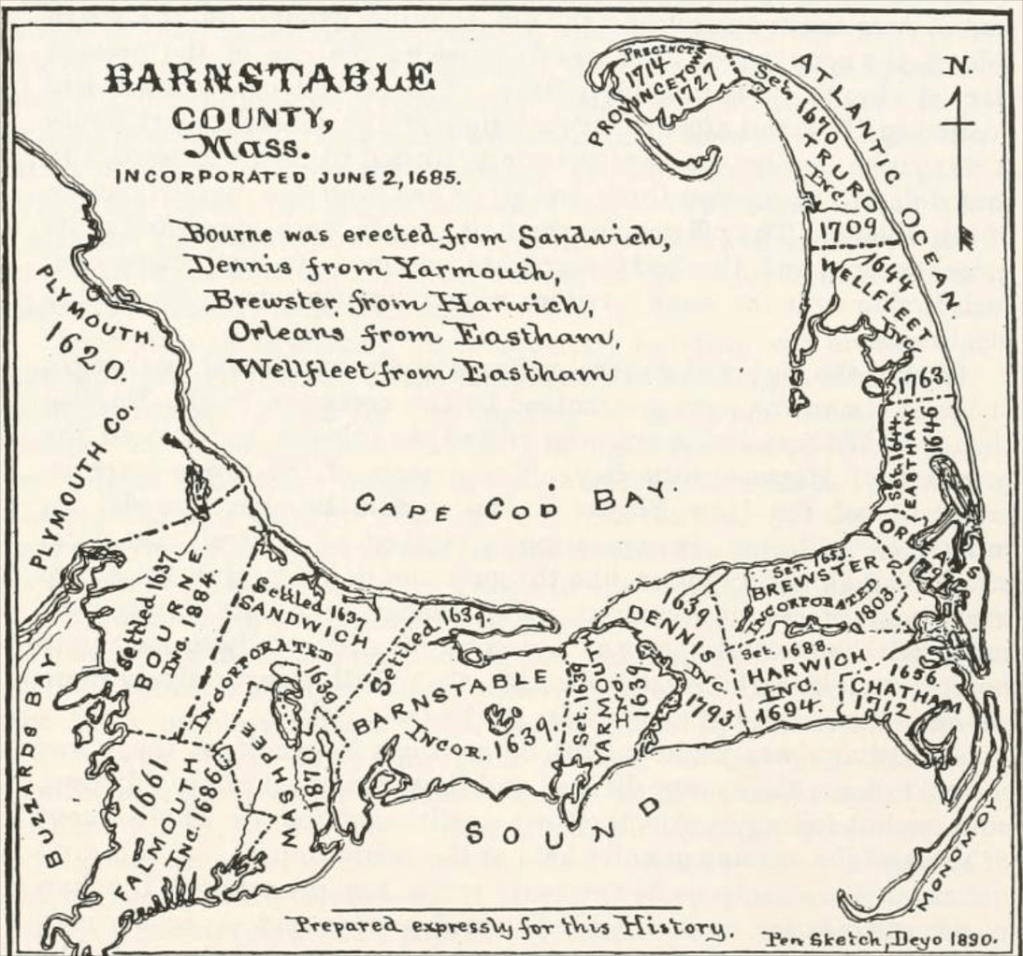
“Mr. Lothropp and the large company arrived in Barnstable, (Oct. 11, 1639, bringing with them the crops which they had raised in Scituate. Pressed as they must have been with the preparations needed for wintering comfortably in their new home, they did not forget that the main object of their pilgrimage from the motherland, was the service and glory of God.[9]
The Lothropp House
John Lothropp’s house is now the Sturgis library at 3090 Main St. in Barnstable. The library has extensive materials for genealogy research and a room set up for researching family histories where we spent several hours.
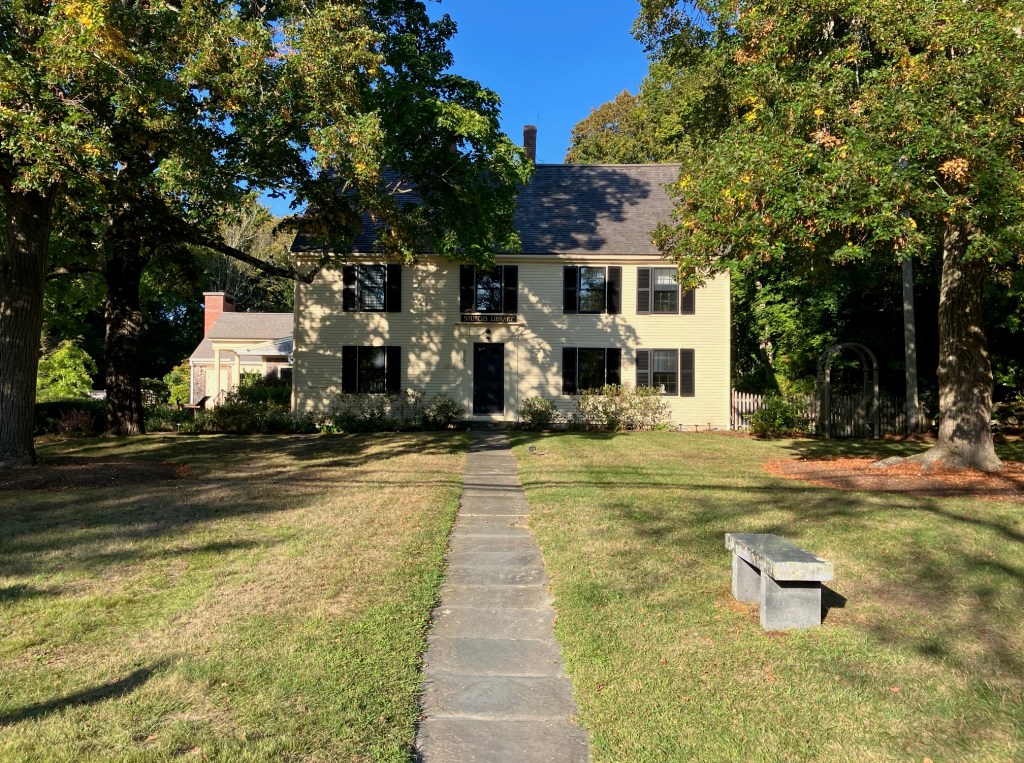
An original room of the house can be accessed by visitors. The room is brightly lit by two windows facing out on the street. The floor consists of very wide wood planks. On display in that room is John Lothropp’s Bible that he brought from England with him on the Griffen, below.
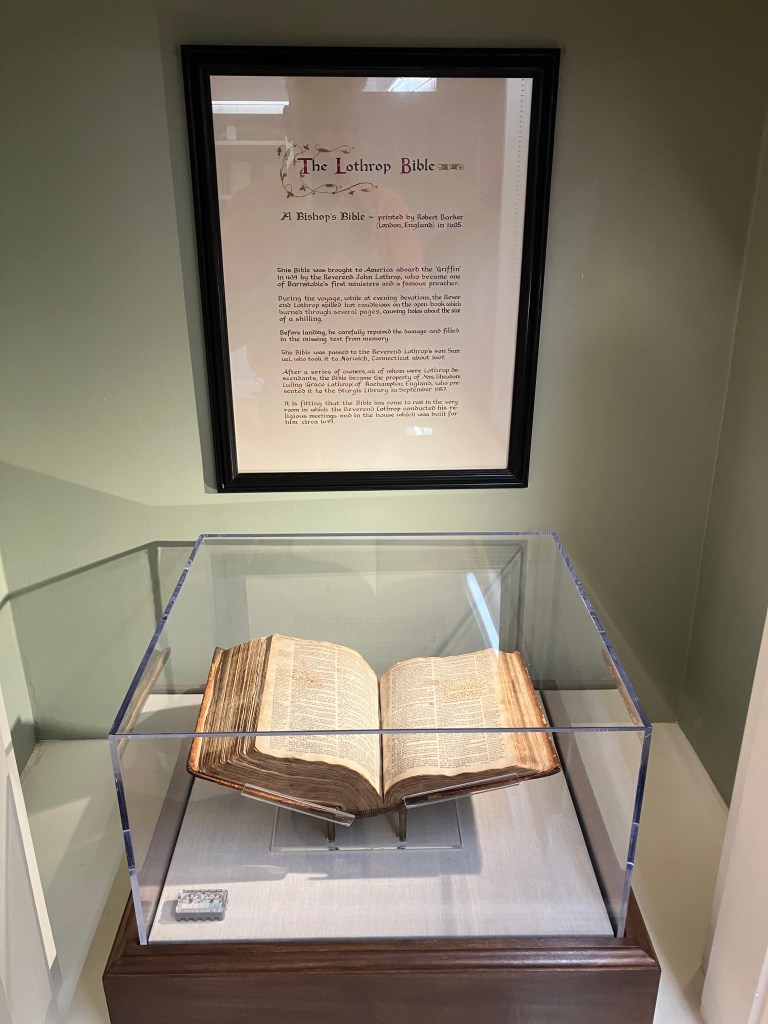
The Lothropp Bible has an interesting story framed above it on display. On his way to America on the Griffen while reading by candle light, hot wax from the candle burned through several spots on pages of the Bible. He repaired the Bible’s damaged pages and rewrote the damaged passages from memory. His writing in the repaired areas is exceedingly small and meticulously neat.
It is inspiring to know the history of an ancestor who persevered in what he believed, through such difficult times and ordeals, who was also such an inspiration to the community that he led. A contemporary described him in these words:
“He was a man of a humble and broken heart and spirit, lively in dispensation of the word of God, studious of peace, furnished with godly contentment, willing to spend, and to be spent, for the cause of the church of Christ. He fell asleep in the Lord, November 8, 1653.”[11]
Copyright Bruce A. Wright, Esq. 2025 ©
[1] Rev. E.B. Huntington, A Genealogical Memoir of the Lo-Lathrop Family in this Country, p. 24-25, Huntington, Ridgefield CT, 1884. https://archive.org/details/genealogicalmemo00byuhunt/page/24/mode/1up
[2] Charles Edward Banks, The Planters of the Commonwealth; A Study of the Emigrants and Emigration In Colonial Times: To Which are Added Lists Of Passengers to Boston and to the Bay Colony; The Ships Which Brought Them; Their English Homes, and the Places of Their Settlement In Massachusetts. 1620-1640, p. 113, Boston, Houghton Mifflin, 1930. https://archive.org/details/plantersofcommon00bank/page/113/mode/1up?q=%22lothrop%22
[3] Charles Edward Banks, The Planters of the Commonwealth; A Study of the Emigrants and Emigration In Colonial Times: To Which are Added Lists Of Passengers to Boston and to the Bay Colony; The Ships Which Brought Them; Their English Homes, and the Places of Their Settlement In Massachusetts. 1620-1640, p. 41, Boston, Houghton Mifflin, 1930. https://archive.org/details/plantersofcommon00bank/page/41/mode/1up?
[4] Rev. E.B. Huntington, A Genealogical Memoir of the Lo-Lathrop Family in this Country, p. 24-25, Huntington, Ridgefield CT, 1884. https://archive.org/details/genealogicalmemo00byuhunt/page/24/mode/1up
[5] Charles Edward Banks, The Planters of the Commonwealth; A Study of the Emigrants and Emigration In Colonial Times: To Which are Added Lists Of Passengers to Boston and to the Bay Colony; The Ships Which Brought Them; Their English Homes, and the Places of Their Settlement In Massachusetts. 1620-1640, p. 19, Boston, Houghton Mifflin, 1930. https://archive.org/details/plantersofcommon00bank/page/19/mode/1up
[6] Rober C. Anderson, The Great Migration Begins: Immigrants to New England 1620-1633, v. 1, p. 47, New England Historic Genealogical Society. Boston, 1995. https://www.americanancestors.org/databases/great-migration-begins-immigrants-to-ne-1620-1633-vols-i-iii/image?rId=235171446&volumeId=12107&pageName=47&filterQuery=
[7] Scituate Historical Society, Map of Early Scituate, https://scituatehistoricalsociety.org/early-families-of-scituate/
[8] Rober C. Anderson, The Great Migration, v. 2, p. 476-479, New England Historic Genealogical Society, Boston 2001. https://www.ancestry.com/imageviewer/collections/2496/images/42521_b158313-00578?
[9] Rev. E.B. Huntington, A Genealogical Memoir of the Lo-Lathrop Family in this Country, p. 26, 31, Huntington, Ridgefield CT 1884. https://archive.org/details/genealogicalmemo00byuhunt/page/26/mode/1up
[10] Simeon L. Deyo, Ed., History of Barnstable County, p. 39, Blake, NY NY, 1890. https://archive.org/details/historyofbarnsta00deyo/page/39/mode/1up
[11] Nathaniel Morton, New England’s Memorial, p. 167-168, Usher, Cambridge, 1669. https://archive.org/details/newenglandsmemor00m/page/166/mode/2up
 The Boating Genealogists