Exploring American history through the lens of personal ancestry is eye opening. When I began my ancestry search I did not expect that the family branches would be intertwined with the earliest settlements of eastern North America. Any family links to the founding of Rhode Island were long lost and obscured by the passage of time. No stories about early Rhode Island were passed down and I knew little about the place.
Wartime destruction destroyed much the history of the early Rhode Island settlers. Many of the records of Providence were destroyed when the town was attacked and burned by Indians in King Philips War in 1676. Some records were burned, some were damaged and some survived.
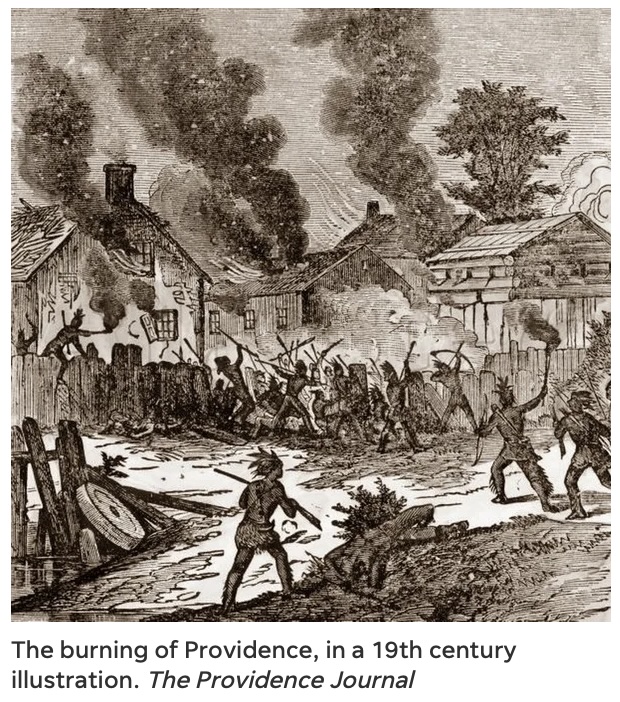
“The town records were thrown from his burning house into the mill pond to preserve them from the flames, and to the present day they bear plenary evidence of the two-fold dangers they escaped, and the two-fold injury they suffered.” [1]
Validation of descent from Revolutionary War soldiers Enos Greenfield and Reuben Blanchard by the genealogists at the Society of the Sons of the American Revolution (SSAR) was the first step in taking their ancestry back to ancient Rhode Island. Clues to Enos and Reubens family histories are found in their Revolutionary War pension files, several books and publications.[2] [3] [4]
Reuben Blanchard’s Revolutionary War pension statement and Blanchards of Rhode Island furnished much of the information needed to locate the history of his family. Enos Greenfield’s Revolutionary War pension statement and Descendants of James Sands of Block Island along with Niles’ History of the Indian and French Wars opens up much of Enos’ ancestry. Combining those sources with vital records on Ancestry.com along with town and state histories gave me the background for this article. The Two James Greenfields was published in The Record by New York Genealogical and Biographical Society shortly after I did my research on Enos Greenfield. It is an excellent article and validated my work up to that time.
Rhode Island colony was settled first at Providence by Roger Williams in 1636 when he fled there from Salem, banished from Massachusetts for religious reasons. Williams, remembered for being first to advocate separation of church and state, was soon followed by Anne Hutchinson and her adherents, religious exiles from Boston that founded Portsmouth Rhode Island in 1638. [5] [6]

SEPARATION OF CHURCH AND STATE
“What does the phrase, “the separation of church and state” mean? The earliest mention of that metaphor comes from Roger Williams, a minister, lawyer, and merchant who desired a way to worship freely. Williams referenced ‘a high wall’ between church and state to keep the ‘wilderness’ of the human institutions out of the affairs of religion.” [7]
Like Roger Williams, Anne Hutchinson held strong religious convictions that set her and her followers at odds with Massachusetts religious leaders. Those convictions fomented controversy and rebellion in the nascent colony and resulted in her exile from Massachusetts.[8] [9] [10]
One of Anne Hutchinson’s followers was John Walker (1603-1647) who arrived to North America in 1633. He was one of Anne Hutchinson’s 59 adherents who were ordered by the government to surrender their muskets, pistols, and swords at Boston on 20 November 1637.[11]
“Whereas the opinions & revelations of Mr. Wheeleright & Mrs. Hutchinson have seduced & led into dangerous errors many of the people here in New England insomuch as there is just cause of suspicion that they as others in Germany in former times may upon some revelation make some sudden irruption upon those that differ from them in judgment for prevention whereof it is ordered that all those whose names are underwritten shall upon warning given or left at their dwelling houses before the 30th day of this month of November deliver in at Mr. Canes house at Boston all such guns pistols swords powder shot & match as they shall be owners of or have in their custody upon pain of ten pound for every default to be made there of which are to be kept by Mr. Cane till this Court shall take further order therein. Also, it is ordered upon like penalty of ten pounds that no man who is to render his armes by this order shall buy or borrow any guns swords pistols powder shot or match until this Court shall take further order therein.” [12]
PORTSMOUTH COMPACT
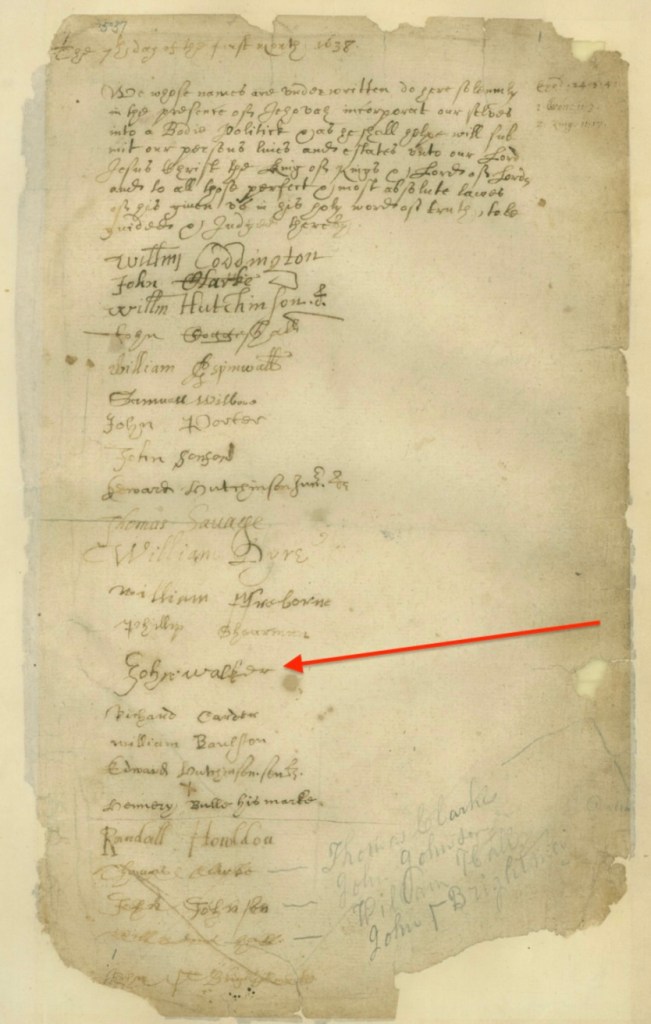
By May of 1638 Portsmouth was being settled by Anne Hutchinson’s followers. They immediately began to form their new government and created an agreement that they would live by called the Portsmouth Compact. John Walker’s signature is on the Portsmouth Compact of 1638.
“We whose names are underwritten do hereby solemnly in the presence of Jehovah incorporate ourselves into a Bodie Politick and as He shall help, will submit our persons, lives and estates unto our Lord Jesus Christ, the King of Kings, and Lord of Lords, and to all those perfect and most absolute laws of His given in His Holy Word of truth, to be guided and judged thereby. Exodus. 24c., 3:4. II Cron., llc., 3. II Kings, II :17”
The Compact was signed by:
| William Coddington | William Dyre | John Clarke |
| William Freeborn | William Hutchinson. Jr. | Philip Shearman |
| Philip Shearman | John Coggeshall | John Walker |
| William Aspinwall | Richard Carder | Edward Hutchinson, Sr |
| Samuel Wilbore | William Baulston | John Sanford |
| John Porter | Henry Bull | Edward Hutchinson, Jr., Esq. |
| Randall Holden | Thomas Savage [13] |
As the colony matured and distributed land, John Walker owned at least two Portsmouth properties.
“John Walker’s land was north of Freeborns Creek, on the west side of the Island. He also owned a small plot in the Calfs Pasture, now part of the Hathaway Peach Orchards.”[15]
John Walker is said to have married Katherine Hutchinson, Anne Hutchinson’s niece-in-law. Certainly, as one of her followers he knew Anne Hutchinson. His son-in-law James Sands built the house at Eastchester New York at which Anne Hutchinson died. Both those facts are indicative of a strong bond between the two families. However, Katherine Walker’s relation to Anne Hutchinson appears to be speculative and unsupported by evidence.[16] [17] The Hutchinson genealogy below appearing in Descendants of James Sands provides us no evidence in support of the genealogy:
“…Edward Hutchinson of Alford, b. there 1564; d. 1631; m. Susanne, and had among other children: Edward Hutchinson of Alford, b. there 1564; d. 1631; m. Susanne, and had among other children: Edward Hutchinson b. 1607; m. Sarah by whom he had Katherine Hutchinson wife of John Walker.” [18]
John and Katherine Walker’s daughter Sarah married James Sands (1622-1695), an early settler of Portsmouth Rhode Island and a first settler of Block Island in Rhode Island.[19] [20
James Sands built a house for Anne Hutchinson after she left Rhode Island for New York. The house was located near Split Rock at Pelham Bay Park, New York.[21] Indians in the area did not want the house built and attempted to warn off the construction.[22] Anne Hutchinson and those of her children that were with her, except for a single daughter, were slaughtered there by Indians in August 1643 during Kieft’s War.[23]

“Mrs. Hutchinson, who came into this country under a religious character, probably not very long after the church at Boston was settled. She was a gentlewoman of prompt parts, and at first in great esteem with the good people there. But (whether before or after her coming hither, is now uncertain), she had imbibed some errors subversive of religion, and of a very dangerous tendency; and being of a more tenacious and resolute temper and disposition than is commonly found among those of her sex, she gave the Church, with some others that joined with her in sentiment, not a little trouble, by advancing Antinomianism and Enthusiasm, and other errors, much like the Separatists among us at this day; until the Church and Court fearing the consequence, the Court ordered her to depart out of the government of the Massachusetts. She accordingly removed to Rhode Island ; but making no long stay there, she went farther westward to a place then called East Chester, now in the eastern part of the province of New-York, where she purposed to settle herself; but not to the good liking of the Indians that lived back in the woods, as the sequel will prove.
In order to pursue her purpose, she agreed with the before-mentioned Captain James Sands, then a young man, to build her house, and he took a partner with him in the business. When they had near spent their provisions, he sent his partner for more, which was to be fetched at a considerable distance. While his partner was gone, there came a company of Indians to the frame where he was at work, and made a great shout, and sat down. After some time, they gathered up his tools, put his broad-axe on his shoulder and his other tools into his hands, and made signs to him to go away. But he seemed to take no notice of them, but continued in his work. At length one of them said, Ye-hah Mumuneketock, the English of which is, ”Come, let us go,” and they all went away to the water side, for clams or oysters. After some time they came back, and found him still at work as before. They again gathered up his tools, put them into his hands as before they had done, with the like signs moving him to go away. He still seemed to take no notice of them, but kept on in his business, and when they had stayed some time, they said as before, Ye-hah Mumuneketock. Accordingly they all went away, and left him there at his work, — a remarkable instance of the restraining power of God on the hearts of these furious and merciless infidels, who otherwise would doubtless in their rage have split out his brains with his own axe”.[25]
Thomas Hopkins (1616-1684) and William Wickenden (1614-1670) signed the 1640 Providence Compact.[26] They and John Smith (the mason) appear on an early plat map of Providence.[27] John Smith is called “the mason” to distinguish him from two other John Smiths in the area. He lived at lot 42 in Providence.[28]Counting the lots sequentially 42 up from Roger Williams’ lot at the bottom of the map below we see John Smith’s lot.

William Wickenden was one of the earliest Baptist Pastors in New England and is the documented 4th Pastor of the First Baptist Church in America.[29] He was one of the signers of the first Providence Compact signed around 1638.[30] A dedicated Baptist, he was arrested in New Netherlands in 1657. His “crime” was baptizing and preaching contrary to the New Netherlands’ Dutch established religious beliefs. He was released later.[31] His daughter Hannah married John Steere (1634-1726) who was in Providence by 1660 and who was town sergeant there in 1663.[32]
PROVIDENCE COMPACT
“We whose names are hereunder, desirous to inhabit in the town of Providence, do promise to subject ourselves in active or passive obedience, to all such orders or agreements as shall be made for public good of the body, in an orderly way, by the major assent of the present inhabitants, masters of families, incorporated together into a town-fellowship, and such others whom they shall admit unto them, only in civil things.”
| Richard Scott | Francis J. Wickes | George Rickard |
| Thomas Angell | Chad Brown | William Wickenden |
| William Reynolds | Benedict Arnold | Edward Cope [33] |
| Thomas Harris | John Warner | |
| John Field | Joshua Winsor |

Alexander Balcom (1630 -1711) was a mason by trade and was at times a resident of both Providence and Portland. He was in Portland by 1664.[35]
William Blanchard (1680-post 1757) was in Providence well before 1704 when he referenced his oldest son Timothy and an Indian named Sam No Force in a deed. Based on the evidence of a lost family Bible it is said that that possibly Moses Blanchard, a Huguenot said to be in Providence by 1679, was William’s father.[36]
The names on the list below are my known earliest Rhode Island ancestors and relations mentioned in the story above. They lived through times of upheaval, experiencing religious intolerance, exile and savage warfare. Some of their stories are obscured by the loss of records while other stories live and shine on with an unquenchable brilliance.
The list below are my earliest Rhode Island settlers.
| William Wickenden 1614-1670 – 10th great-grandfather (ggf) |
| Thomas Hopkins 1616-1684 – 9th ggf |
| John Smith the mason -9th ggf |
| John Walker 1603-1647 & Katherine (Hutchinson?) -11th great-grandparents (ggp) |
| James Sands 1622-1695 & Sarah Walker – 10th ggp |
| Alexander Balcom 1630 -1711 & Jane Holbrook 1640-1696 – 9th ggp |
| John Steere 1634 – 1726 & wife Hannah Wickenden 1638-1705 – 9th ggp |
| William Blanchard 1680-after 1757 – 8th ggf |
[1] William R. Staples, Annals of the Town of Providence, p. 165-166, Knowles and Vose, Providence, 1843. https://play.google.com/books/reader?id=OPo1UnWXBLUC&pg=GBS.PA166
[2] Thomas W. Jones, PhD CG FASG, The Two James Greenfields, The New York Genealogical and Biographical Record, p. 245-263, v. 147, number 4, October 2016.
[3] Adelaide M. Crandall, Blanchards of Rhode Island, Edward Bros., Ann Arbor MI, 1942. https://babel.hathitrust.org/cgi/pt?id=mdp.39015068086258&seq=7
[4] Gerald McFarland, A Scattered People, p. 24-28, Random House, New York, 1985.
[5] Richard B. Morris, ed., Encyclopedia of American History, p.33, 679, Harper, NY, 1953.
[6] Roger Williams, Rhode Island Founder, Library of Congress. https://www.loc.gov/item/today-in-history/february-05/#:~:text=Roger%20Williams%2C%20defender%20of%20religious,a%20haven%20for%20religious%20dissidents.
[7] National Park Service, Separation of Church & State History, Last updated April 1, 2025. https://www.nps.gov/articles/000/church_state_historical.htm
[8] Richard B. Morris, ed., Encyclopedia of American History, p.34, 679, Harper, NY, 1953.
[9] Anne Hutchinson, Wikipedia, https://en.wikipedia.org/wiki/Anne_Hutchinson , last accessed April 3, 2025.
[10] Thomas Williams Bicknell, LL.D., The History of the State of Rhode Island and Providence Plantations, v. 1, p. 263-268, The American Historical Society, New York, 1920. https://archive.org/details/historyofrhod01bick/page/263/mode/2up
[11] Robert Charles Anderson, The Great Migration Begins: Immigrants to New England, 1620-1633 V.1-3, v. 3, p. 1906-1908, New England Historical and Genealogical Society, Boston, 1996-2011.
[12] Nathaniel B. Shurtleff, ed., Records of the Governor and Company of the Massachusetts Bay in New England, 1628-1686, v.1, p. 211-212, W. White, Boston 1853. https://www.google.com/books/edition/Records_of_the_governor_and_company_of_t/eXSQKjSsbwMC?hl=en&gbpv=1
[13] Thomas Williams Bicknell, LL.D., The History of the State of Rhode Island and Providence Plantations, v. 1, p. 290-292, The American Historical Society, New York, 1920. https://archive.org/details/historyofrhod01bick/page/290/mode/2up
[14] Rhode Island Secretary of State, Portsmouth Compact 1638, https://sosri.access.preservica.com/uncategorized/IO_8b5544ae-7a9e-4b1e-aaee-fc726bec402d/
[15] Edward H. West, History of Portsmouth Rhode Island, unpaginated, https://archive.org/details/historyofportsmo00west/page/n41/mode/2up?q=%22john+walker%22
[16] Anne Hutchinson, Wikipedia, https://en.wikipedia.org/wiki/Anne_Hutchinson last accessed April 3, 2025.
[17] Lockwood Barr, A Brief, but Most Complete & True Account of the Settlement of the Ancient Town of Pelham, Westchester County, State of New York, p. 7, A. Dietz and son, Richmond, 1946. https://archive.org/details/briefbutmostcomp00barr_0/page/8/mode/2up?view=theater
[18] Malcolm Sands Wilson, Descendants of James Sands of Block Island, p. 83, Private Printing, New York, 1949. https://archive.org/details/descendantsofjam00wils_0/page/83/mode/1up?view=theater
[19] Malcolm Sands Wilson, Descendants of James Sands of Block Island, p. 3, Private Printing, New York, 1949. https://archive.org/details/descendantsofjam00wils_0/page/3/mode/1up?view=theater
[20] Thomas Williams Bicknell, Ll.D., The History of the State of Rhode Island and Providence Plantations, v. 2, p. 520-521, The American Historical Society, New York, 1920. https://archive.org/details/historyofrhod02bick/page/520/mode/2up
[21] Pelham Bay Park, Split Rock, https://en.wikipedia.org/wiki/Pelham_Bay_Park#Split_Rock
[22] Rev. Samuel Niles, Niles’ History of the Indian and French Wars, in Collections of the Massachusetts Historical Society v. 6 of the Third Series, p. 198, American Stationers, Boston, 1837. https://archive.org/details/collectionsofmas36mass/page/198/mode/1up?view=theater&q=hutchinson
[23] Lockwood Barr, A Brief, but Most Complete & True Account of the Settlement of the Ancient Town of Pelham, Westchester County, State of New York, p. 8-9, A. Dietz and son, Richmond, 1946. https://archive.org/details/briefbutmostcomp00barr_0/page/8/mode/2up?view=theater
[24] William Cullen Bryant and Sydney H. Gay, A Popular History of the United States, v. 1, p. 457, Scribner, Armstrong, New York 1876. https://archive.org/details/popularhistoryof00brya/page/456/mode/2up?view=theater
[25] Rev. Samuel Niles, Niles’ History of the Indian and French Wars, in Collections of the Massachusetts Historical Society v. 6 of the Third Series, p. 198-199, American Stationers, Boston, 1837. https://archive.org/details/collectionsofmas36mass/page/198/mode/1up?view=theater&q=hutchinsonSamuel
[26] William R. Staples, Annals of the Town of Providence, p. 40-43, Knowles and Vose, Providence, 1843. https://play.google.com/books/reader?id=OPo1UnWXBLUC&pg=GBS.PA42&hl=en
[27] Edward Field, State of Rhode Island and Providence Plantations at the end of the Century, v. 3, p. 9, Mason, Boston, 1902. https://www.loc.gov/resource/gdcmassbookdig.stateofrhodeisla04fiel/?sp=21
[28] John O. Austin, The Genealogical Dictionary of Rhode Island, p. 380, Munsells, Albany, 1887. https://archive.org/details/genealogicaldict00aust/page/380/mode/1up?view=theater
[29] Henry Melville King, Compiler, Ed., Historical Catalogue of the Members of the First Baptist Church in Providence Rhode Island, p. 23, Townsend, Providence R.I., 1908. https://play.google.com/books/reader?id=MylOAQAAMAAJ&pg=GBS.PA22&hl=en
[30] John O. Austin, The Genealogical Dictionary of Rhode Island, p. 224, Munsells, Albany, 1887. https://archive.org/details/genealogicaldict00aust/page/224/mode/1up?view=theater&q=%22william+wickenden%22
[31] J. Franklin Jameson, Ed., Narratives of New Netherlands, p. 397, 400, Scribner, New York, 1909. https://archive.org/details/narrativesofnewn01jame/page/400/mode/1up?q=wickenden&view=theater
[32] James Pierce Root, Steere Genealogy, A Record of the Descendants of John Steere, p. 32, Riverside Press, Cambridge, 1890. https://babel.hathitrust.org/cgi/pt?id=wu.89066287194&seq=62
[33] William R. Staples, Annals of the Town of Providence, p. 39, Knowles and Vose, Providence, 1843. https://play.google.com/books/reader?id=OPo1UnWXBLUC&pg=GBS.PA39&hl=en
[34] The American Genealogist, from Providence City Archives, 1638 Providence Compact . https://americangenealogist.com/the-providence-civil-compact-high-resolution-color-image/
[35] John O. Austin, The Genealogical Dictionary of Rhode Island, p. 10, Munsells, Albany, 1887 https://archive.org/details/genealogicaldict00aust/page/10/mode/1up?view=theater&q=balcom
[36] Adelaide M. Crandall, Blanchards of Rhode Island, p.viii-ix,2,5, Edward Bros., Ann Arbor MI, 1942. https://babel.hathitrust.org/cgi/pt?id=mdp.39015068086258&seq=13
Bruce A. Wright, Esq., © 2025
 The Boating Genealogists