For sometime now I ignored researching my Taylor ancestors because many of the Taylors already seemed well documented with nice biographical summaries in multiple publications. However, this past summer we sailed from the Lake Erie Islands (Put-in-Bay and Middle Bass Island) and due to heavy weather docked at the 55th East Street Marina along Cleveland’s downtown shoreline for five days.
Stuck in Cleveland with only our folding bikes to get around we soon learned we could get to the Western Reserve Historical Society and the main Cleveland Library pretty easily, first biking through Rockefeller and Cleveland Cultural Parks towards the art and museum district, and then biking west on Euclid Avenue. Euclid Avenue is one of the original spoke roads into downtown and the Public Square near the main Cleveland Library and the Erie Street Cemetery. What we discovered in Cleveland provided meaningful detail and nuance to Elisha Taylor (1785 – 1861), my 4th great grandfather, and his family’s lives, as they grew with Cleveland and its incredible expansion from the early 1800s through the 1890s.
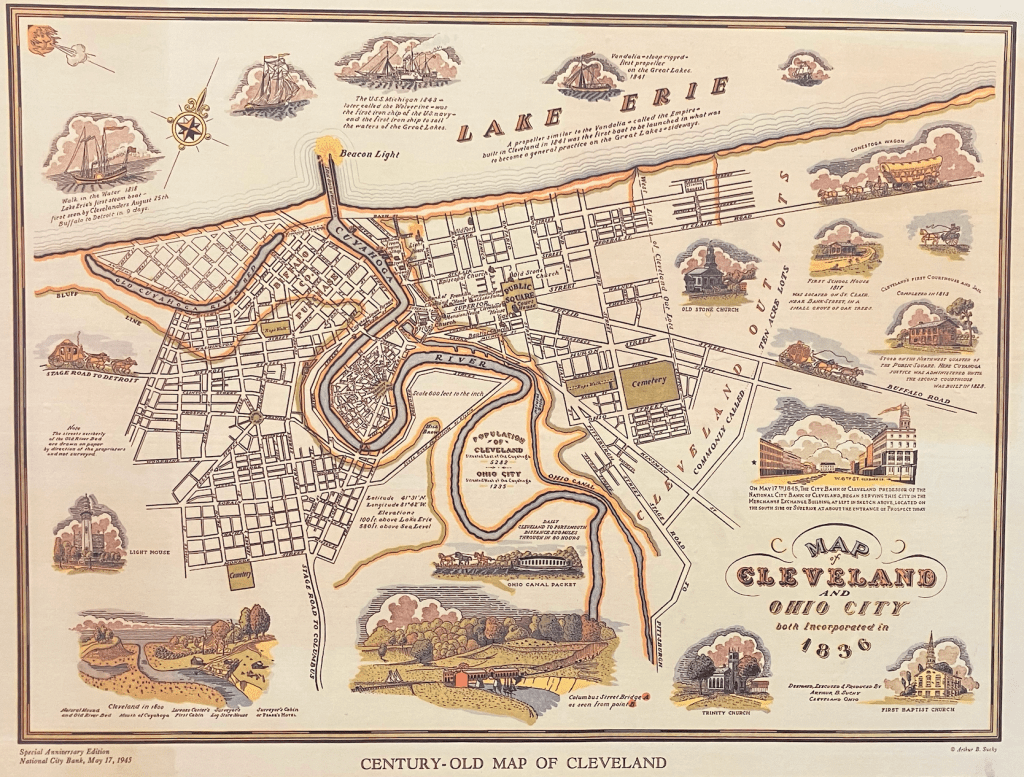

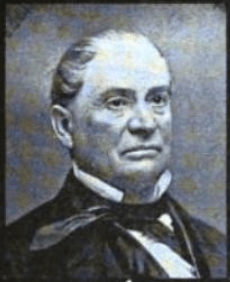
Prior to his arrival Elisha Taylor moved to Cleveland, Ohio from Charlton, Saratoga County, New York in 1816 with his wife Anna Dunlap Taylor. Elisha graduated in law from Union College (1810) and was a major in the War of 1812. Cleveland in 1816, was a town of approximately 600 people. Elisha opened one of the earliest dry goods stores that dealt primarily with the new white settlers more than the Indians who traded mostly in furs.1 2 3
In 1820 Elisha was a Charter member of the Old Stone Presbyterian Church. The church was located on the Public Square and was one of the first Cleveland congregations established.4 In 1824 his wife Anna died from malaria a week after giving birth to John William Taylor (1824 – 1896). My 3rd great grandfather John William Taylor was one of their three children that lived to adulthood, several others dying in childhood. After Anna Taylor died Elisha sold off his remaining dry goods inventory along with some local real estate and moved in 1826 to Cherry Valley, Saratoga County, New York.5
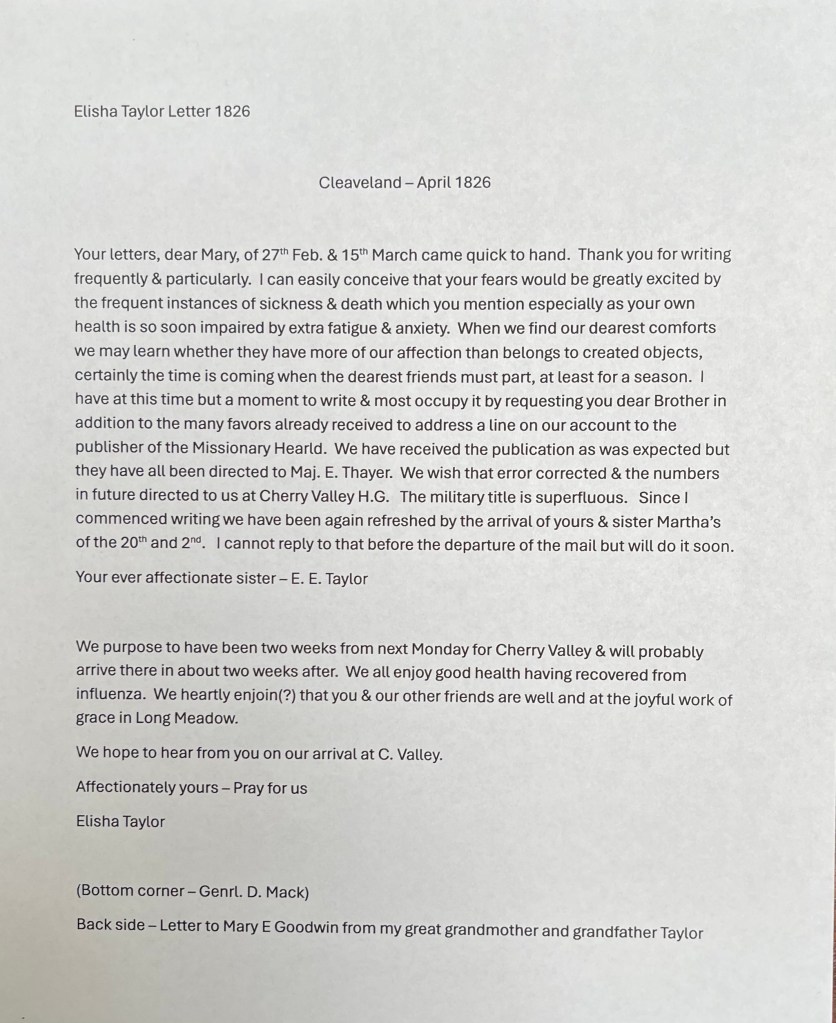
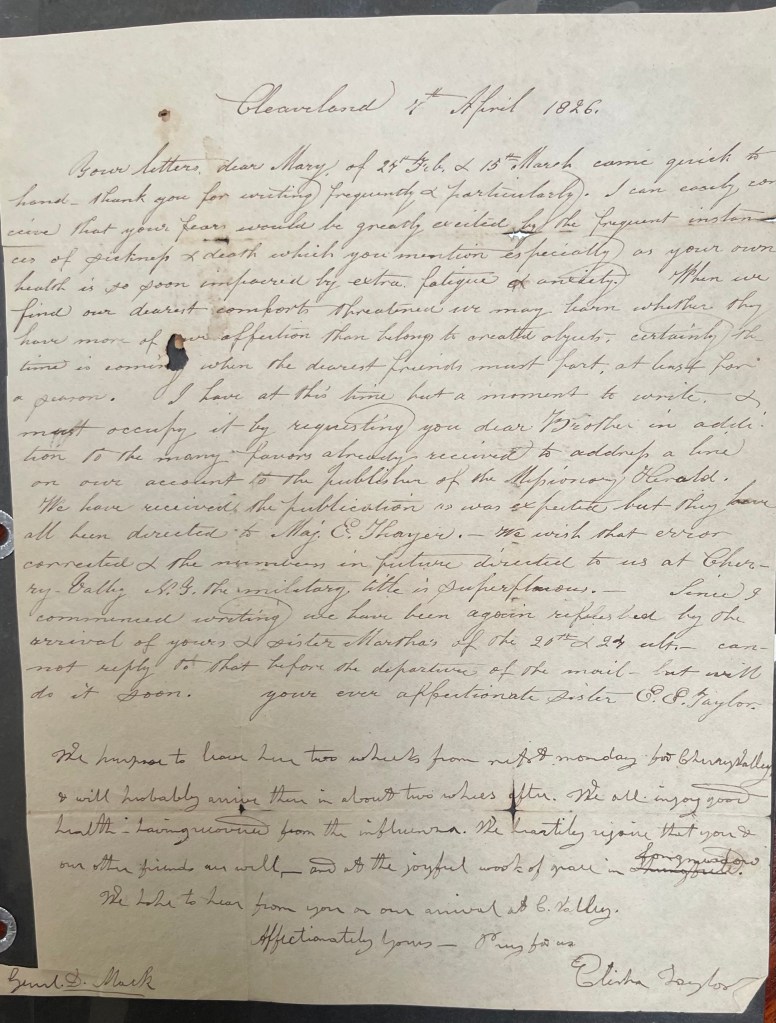
When Elisha returned to Cleveland in 1842 with his family and his 2nd wife, Elizabeth Ely Taylor he became a partner in Morgan & Co, a dry goods store in downtown. He also brought with him what would be an enormous focus of his life, his very public temperance leadership role that he established in New York during the 1830s.

Cleveland had changed in the intervening 20 years since Elisha first left town. Cleveland was now recognized as a major port on the Great Lakes with hundreds of ships loading and unloading raw material and merchandise monthly.6 The Ohio and Erie Canal, which opened in 1832 connected Lake Erie with the Ohio River, Pittsburgh, and ultimately the Gulf of Mexico. The canal was in full operation by the time of Elisha’s return, transporting locally produced items like farming tools, barrels for shipping salted meat, flour, and other food products, and household furnishings.7
Cleveland’s industrial base had blossomed. “In 1837 the city was reported to have 4 iron foundries making steam engines and other products, 3 soap and candle works, 2 breweries, a window-sash factory, 2 ropewalks, a pottery, 2 carriagemakers, 2 millstone shops, and a large flour mill under construction. At the time of the U.S. manufacturing census of 1860, the most valuable industrial product of Cleveland was iron, while the manufacture of items made from iron was also very important. Like many other Great Lakes cities, Cleveland had a large flour-and-gristmilling industry (ranking 2nd in value of product), which served the productive Midwest farms.” 8
By 1840 Cleveland’s population was more than 6,000, increasing again by 1850 to 17,000. In 1853 Cleveland merged with Ohio City across the Cuyahoga River for a combined total population of more than 23,000. The city continued to grow through the end of the century, doubling its population each decade.9
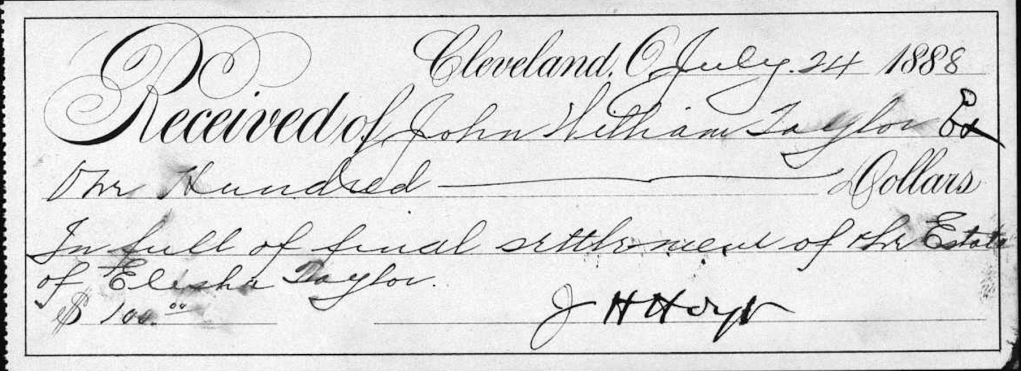
Seeing this much potential future population growth Elisha Taylor and James Madison Hoyt purchased hundreds of acres together. They subdivided their acreage into family home plots and sold directly to the individual families that were migrating to Cleveland. “Major subdivisions on the south and west sides during this period… including, by Taylor and Hoyt (1852)… altogether totaling several thousand lots.“10 When Elisha dies in 1861 his son John William Taylor became the executor of Elisha’s estate and continued to sell lots with Hoyt at least through 1888.
Elisha’s story is incomplete without further illumination of several other dominant themes across his life: temperance, family and opportunity.
Temperance

Elisha Taylor had strong beliefs that he actively, financially and publicly pursued. When he initially settled in Cleveland Elisha focused on religion, education and his dry goods business, as temperance was not his priority in these early years. For example, Elisha was the first Superintendent of the original Cleveland Sabbath School.11
Additionally, Elisha was instrumental in establishing the Old Stone Church, a Presbyterian denomination and one of the first churches in Cleveland.12 “During June of 1819 a Sunday School had been started by a few earnest Christian men and women. Mr. Elisha Taylor, a Presbyterian, was elected super-intendent. Some forceful character usually inspires incipient religious movements, and this seems to have been especially true of Mr. Elisha Taylor, the first super-intendent and afterwards a ruling elder.”13
The Reverend Dr. W. H. Goodrich described Mr. Elisha Taylor as, “He was probably the equal of any of his contemporaries in natural gifts; and his education and culture were superior to theirs. He was a man of inflexible resolve, as well as of very sudden and intense emotions; and if sometimes in his haste he aroused enmity toward him-self, or even the cause he professed, no one could observe him nearly and thoroughly without feeling the power of a genuine, earnest and powerful Christianity.“14

When Elisha Taylor returned to Cleveland in the early 1840s he continued the very public temperance advocacy that he began in the 1830s in New York. There, he was editor for the weekly Temperance Recorder, and Chairman of the Committee of the New York State Temperance Society, a part of the American Temperance Union. In fact, Elisha estimated that he was spending a quarter of his income and time supporting the Temperance cause.15 16 17
Elisha explained his energetic support for temperance with the following personal story recorded in Letter to the Friends of Temperance in Massachusetts by Justin Edwards in 1836: “When I was five or six years old, I was taken to my father’s “case,” by an older brother, and drank spirit until I became so drunk as to be nearly twenty-four hours without knowing anything. The whole family were alarmed–the neighboring physicians called in, and death was expected to ensue. This debauch gave me a decided antipathy to strong drink.”18
Elisha then talks about his apprenticeship when at 16 years old, and all the jeers, jokes, and name-calling he was submitted to only because he did not follow the all day drinking custom of the shop. Instead he diluted his drink with water as a compromise to his position that one should generally refrain from drinking. In the end a new apprentice joined forces with Elisha and, along with other shopmates that were in bad health due to drink, all the shopmates began to drink temperately. This change in behavior was illuminating to Elisha. Drinking was so prevalent in the 1800s that total abstinence was difficult to imagine, let alone accomplish. Nonetheless, Elisha stopped drinking distilled spirits and found his acid stomach markedly improved. Finally he stopped consuming wine & beer, and then cider and cordials. Elisha was committed to the Temperance cause not just health benefits.19
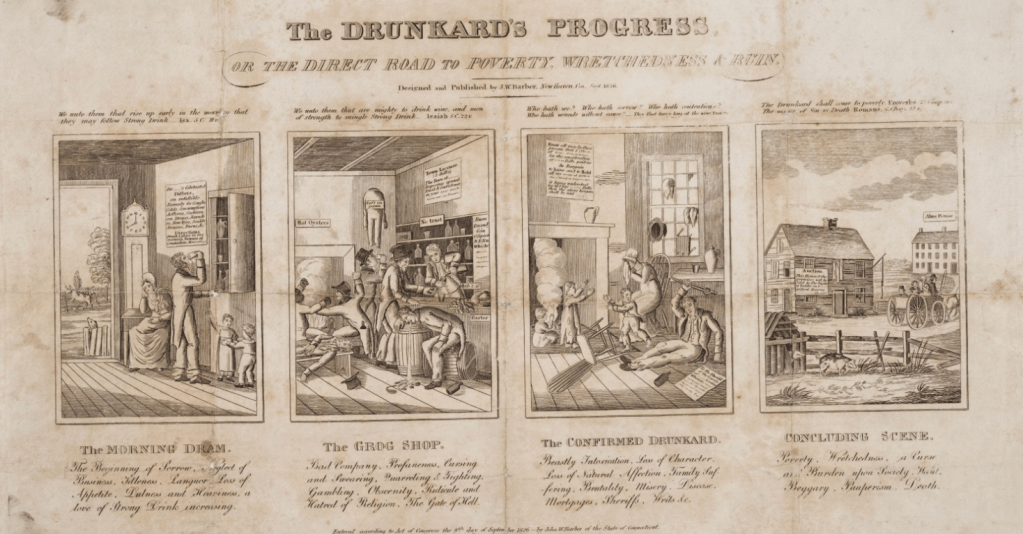
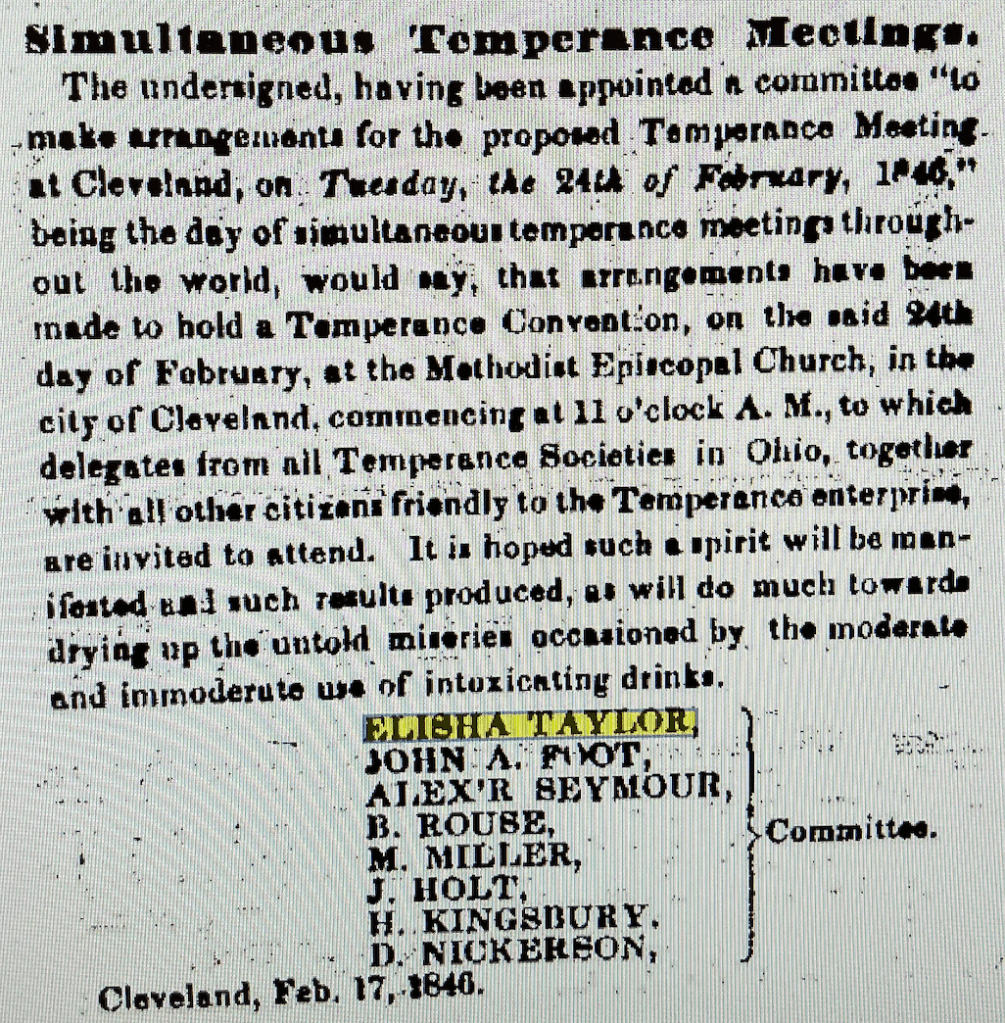
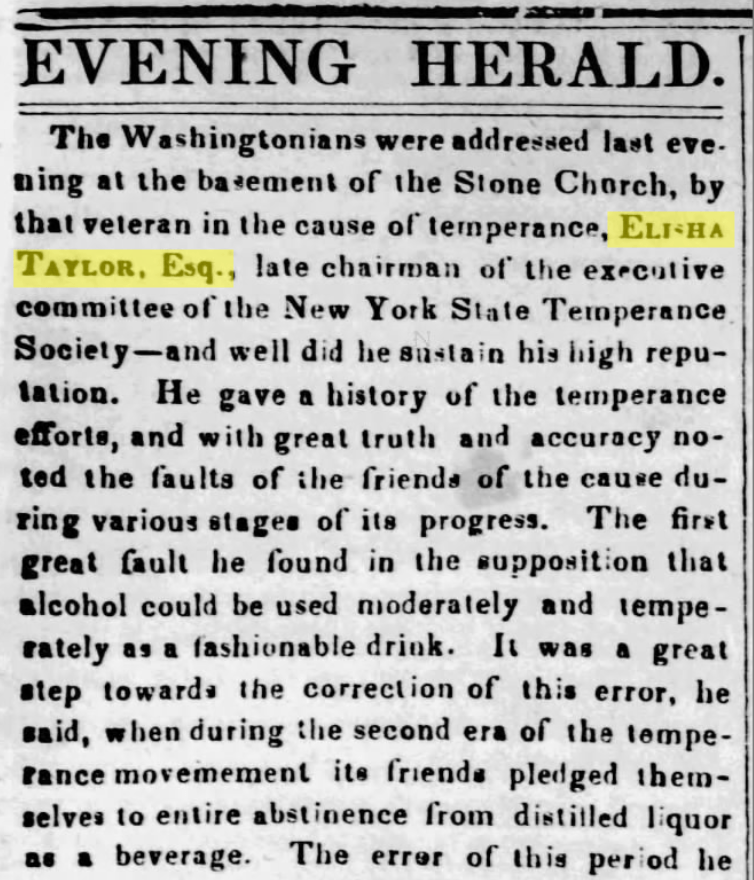
When Elisha Taylor moved back to Cleveland he immediately took leadership roles in the Cleveland, Cuyahoga County and Ohio State Temperance organizations. These organizations had grown while Elisha was in New York. According to the 1845-6 Cleveland City Directory, “[t]here are at present in the city five Temperance Societies, containing in all about four thousand members.“20 There are numerous examples of Temperance meeting advertisements and articles in Cleveland’s Plain Dealer and The News and Evening Herald newspapers through-out the 1840s and into the early 1850s exhibiting Elisha’s leadership role, as shown below.21

The Temperance movement that began in Saratoga, New York in 1808 initially gained adherents slowly. By the 1830s when Elisha seems to have fully engaged in the movement, Temperance proponents had joined forces with Christian institutions, the anti-slavery movement, the Suffragettes, and other reform movements of the day thus becoming America’s new driving political and cultural force.22 Also, U.S. alcohol consumption per capita had grown to an astonishing 7 gallons per year per person by 1830 (the equivalent of about 2 bottles of whiskey per week per person). In some locations like Albany, New York it was a whopping 10 gallons per year per person. In comparison, today’s alcohol consumption is approximately 2.3 gallons per year per person, which is close to where it was prior to 1830s.23 Clearly, the excessive drinking problem Elisha was fighting was very real.
Decades long efforts from Temperance leaders like Elisha Taylor ultimately led to change. Connected to a large body of like-minded constituents the Temperance cause moved forward even after the death of many of its original leaders. By 1919 the Temperance movement resulted in the Eighteenth Amendment to the United States Constitution that established prohibition of the production, sale, and transportation of alcohol for consumption. However, by 1933 the amendment was repealed. Public sentiment had changed, the federal government found it expensive and difficult to enforce, and prohibition had led to a serious increase in criminal activity.24 Nevertheless, Americans have not come close to the extreme alcohol consumption levels seen in the early days of the Temperance movement.
Family
Elisha’s strength of character, love of country and endless drive were decidedly influenced by his family. Reviewing Elisha’s birth family, close family relations and offspring it becomes clear that through the extended Taylor family, family members acquired the tools, the means, the relationships and knowledge to thrive.

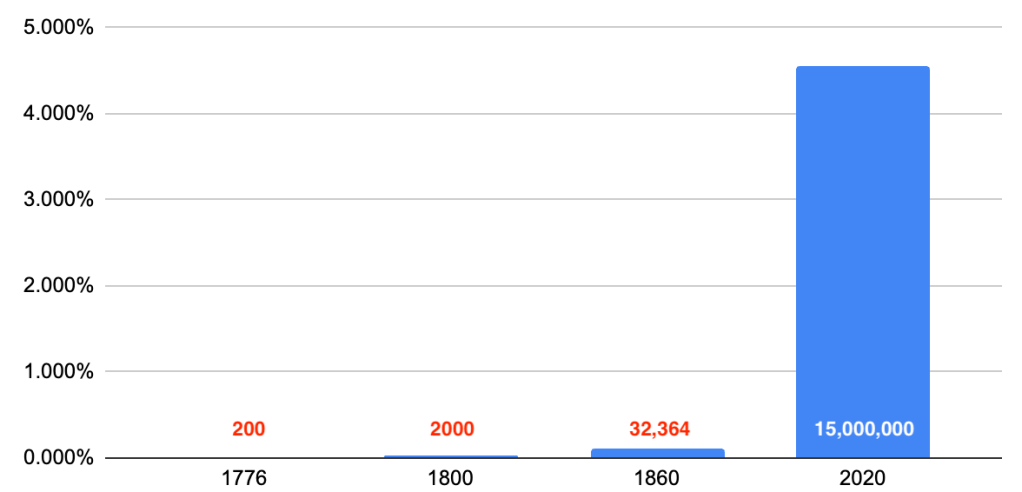
At a macro-level, we see that the Taylor’s pursuits and occupations were reflective of an educated, well-off group, especially compared to the times they lived in. Across a subset of four Taylor generations from the Revolutionary War, through the Civil War, and into early American Industrialization we find (see chart above): nine lawyers, nine military officers, one private, three politicians, two merchants, five farmers and one medical doctor, with 12 individuals educated all the way through college (as shown in the above this chart).25 It is worth noting that lawyers were very rare during the 1700s and early 1800s at a time when the Taylors had three in their family. Nationally, that number increased each decade and by 1860 there was approximately one lawyer for every 236 citizens, similar to today’s ratio of one lawyer for every 259 citizens.26 In addition, the number of college educated Americans in 1800 was miniscule, the Taylors again are an outlier (see chart for details).
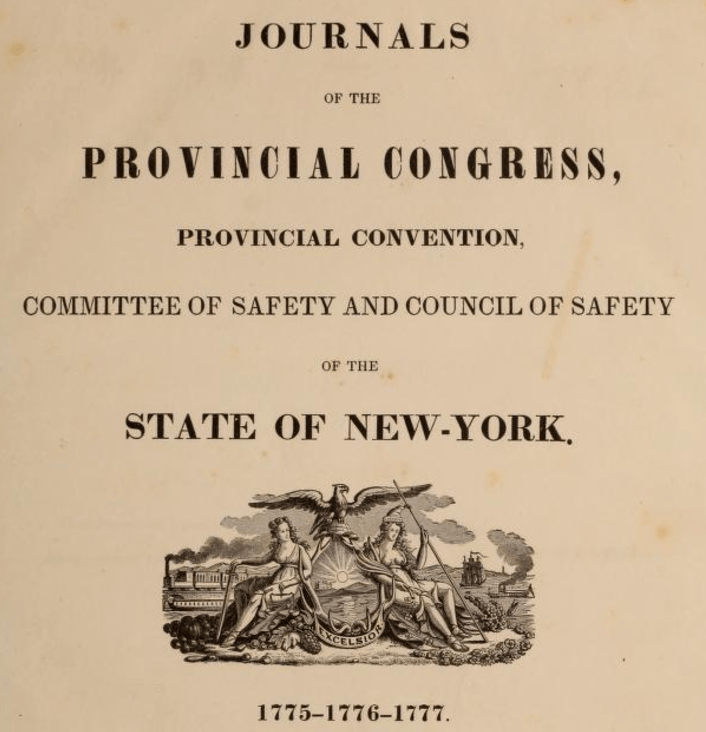
Elisha’s father, John Taylor, was a member of the Provincial Congress (1776), a member of the Committee of Safety (1777) writing letters to/from Alexander Hamilton and George Washington, many years a New York Senator, and for ten years Lieutenant Governor of New York.27
Elisha’s mother was the daughter of Colonel Richard Cox.28 Though we can’t place Colonel Richard Cox’s specific military engagement, he was considered quite influential. This is explained in The Cox Family of America as follows: “Richard Cox called ‘Colonel Richard,’ perhaps from a military service rendered in old training days; name not on the roster of N.J. officers of the Revolution; designated on tombstone, as ‘Richard Cox, Esq’.“29
Elisha’s brother, the Honorable John William Taylor, was a U.S. Congressman from 1813 to 1833 and twice was Speaker of the House of Representatives (and the first congressman to push for slavery abolition on the House of Representatives floor).30
Elisha’s uncle, the son of Colonel Richard Cox, Major Richard Cox was a highly respected Revolutionary War officer.31 On top of this the Taylor women married educated and well-off men like Daniel Holmes who was an early settler and farmer in Wilson, New York, along with Wilson’s first town clerk, and Ezra Sprague who rented homes in Syracuse, New York.32 33 In addition, Elisha and his brothers married into very influential families (e.g. Dunlap’s, Ely’s, Beattie’s, Harger’s).
The next Taylor generation was also educated and driven, but with some significant differences. Elisha’s adult male children graduated from college, Alfred became a medical doctor and John William became a banker.34 35 Similarly, Louisa married a lawyer. Elisha’s nephew, also called Elisha Taylor, moved to Detroit, Michigan and was regarded as one of Detroit’s preeminent lawyers.36 Similar to their parents, Alfred, John William and their cousins married into well-off, influential families (e.g. Cushing’s, Sexton’s, Leonard’s).
Nevertheless, this Taylor generation was much less noted for their leading edge political stances and were overall much less publicly involved than their parents, especially on controversial topics. In fact, they did not publish articles to end slavery or eliminate alcohol consumption as their fathers had done. Some of their wives did charitable work, but this was a well-honed female role in the mid-1800s, nothing that pushed current cultural or political boundaries.
Clearly the Taylor family had meaningful proximity to the outspoken reformers and leaders of their day, in addition to some being leaders and reformers themselves (e.g. patriots, temperance, abolitionists), but what else does family offer that can be leveraged in one’s life?
In the case of the Taylors their family was very supportive of one another as stated in Saratoga County History Center’s Taylor Family Files summary, “This [Taylor] collection richly shows how life was led by educated and landed farming families in the 19th century. Deeds and correspondence show how land moved around within the family, bonds show how family members managed and shared money, and correspondence relates how hard and tenuous life was with considerable discussion of money, business, and illnesses. Correspondence also shows how important family connections were both between blood relatives and through marriage. This collection also shows how families began moving west to find land with Taylor family members moving west to Ohio, Michigan, and Illinois.“37

Some of the Taylor family support came in the form of “disaster relief”. For example, when Anna Dunlap Taylor died right after giving birth to John William, Elisha moved back to New York close to where his birth family resided to remarry and raise his three children. Once Elisha’s children were grown he moved back to Cleveland.

Similar family support was provided when John William Taylor’s first wife Anna Sexton Taylor died right after giving birth to Anna Louisa Taylor. Anna Louisa lived with family members while growing up, but seemingly not with her father. For example, in the 1860 U.S. Census she is living in Elisha Taylor’s household.38 After Anna Louisa Taylor graduated from Vassar College in 1869, she married George Washington Lewton.39 She certainly reflected the Taylor family values of education and marrying into influential families.
Another example of family adhesion and assistance is that when the Honorable John William Taylor (Elisha’s brother) had a stroke that palsied him in 1843 he moved to Cleveland to live with his daughter Sarah Jane Taylor Beattie.40 In fact, we even see John William (Elisha’s son) living with his cousin Sarah Beattie’s family in 1848.41 Family support even in extended times of need was clearly the underlying principle of the Taylor family.
Critical inside knowledge must have also helped Taylor family members make key financial decisions. Where will the ports, canals, bridges, roads, and railroads be built or expanded? Based on transportation, jobs and land availability and cost where will migrants and immigrants locate? How will the War of 1812 or the Civil War’s needs impact industry and population? The Taylors likely had as good a view into the coming transportation, industry and population shifts as any well-positioned family of their time.
Opportunity
Each generation has their own opportunities and challenges. The opportunities available to Elisha Taylor’s generation were outstanding — historically unique and quite large. In particular, the Taylors were positioned to anticipate and leverage territorial, technological, political, population and societal changes. In the early 1800s, many of the Indian Wars were over, the Revolutionary War was over, the Western Territories were ceded, purchased, or annexed, and immigration was as high as anytime in U.S. history. Countless inventions established many industries and redefined occupations and living circumstances for the population as a whole were improving.
As an example, following the U.S.’s huge increase in land area the U.S. overtly encouraged immigration from Europe. The Louisiana Purchase in 1803 extended United States sovereignty across the Mississippi River, nearly doubled the nominal size of the country and created 17 new states. After the purchase President Thomas Jefferson immediately commissioned the Lewis and Clark Expedition in order “to find a practical travel route across the western half of the continent—directly avoiding the hot and desolate desert southwest — and to establish an American presence in the new lands before European powers attempted to establish claims of their own“42.


In order to retain and create value from these newly acquired lands the U.S. needed lots and lots of immigrants, which coincided with huge pressures on the Irish due to the 1845-7 Potato Famine and German economic and political problems. “The growing population of Prussia and the independent German states outstripped the available land. Industrialization could not provide decent-paying jobs, and political rights were limited. Dissatisfied with the lack of land and opportunity, many Germans left.“43 To put this in context, “More than one-half of the population of Ireland emigrated to the United States… This wave of immigration affected almost every city and almost every person in America. From 1820 to 1870, over seven and a half million immigrants came to the United States — more than the entire population of the country in 1810.“44
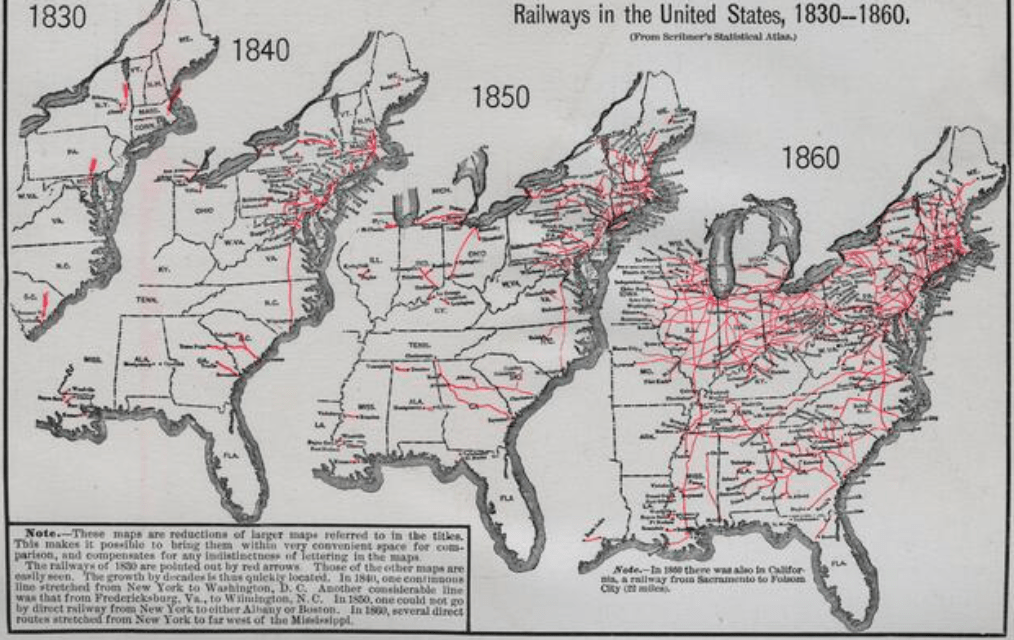
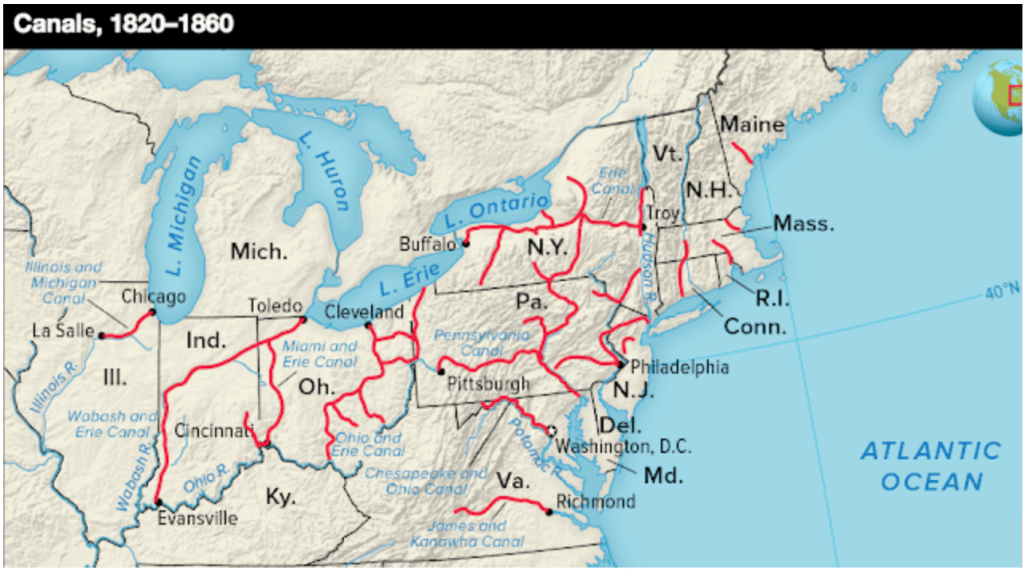

In this same timeframe technological changes put industrialization and its associated infrastructure on turbo charge. First, transportation improvements markedly changed the ability of people and goods to move throughout the country. Major transportation changes included the railroad (1826), canals (e.g. Erie Canal completes in 1825, Ohio & Erie Canal completes in 1836), the Oregon Trail (supporting wagon train travel from east to west across the U.S. completed in 1839), plank roads (locally enabling significantly increased travel speeds and safety), and the steam engine (heavily used for steam ships transporting people and goods through-out the country, and of course steam engine trains).45 46 47 48 49 50
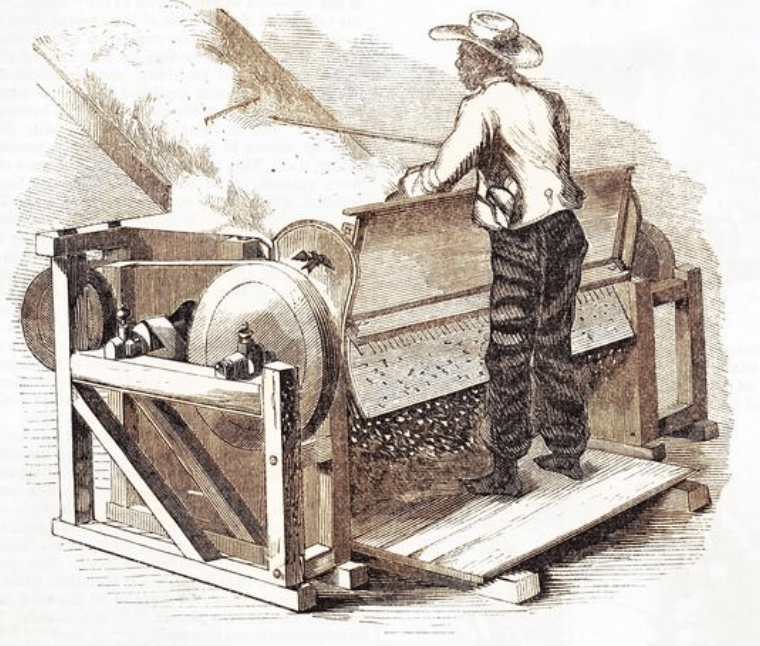
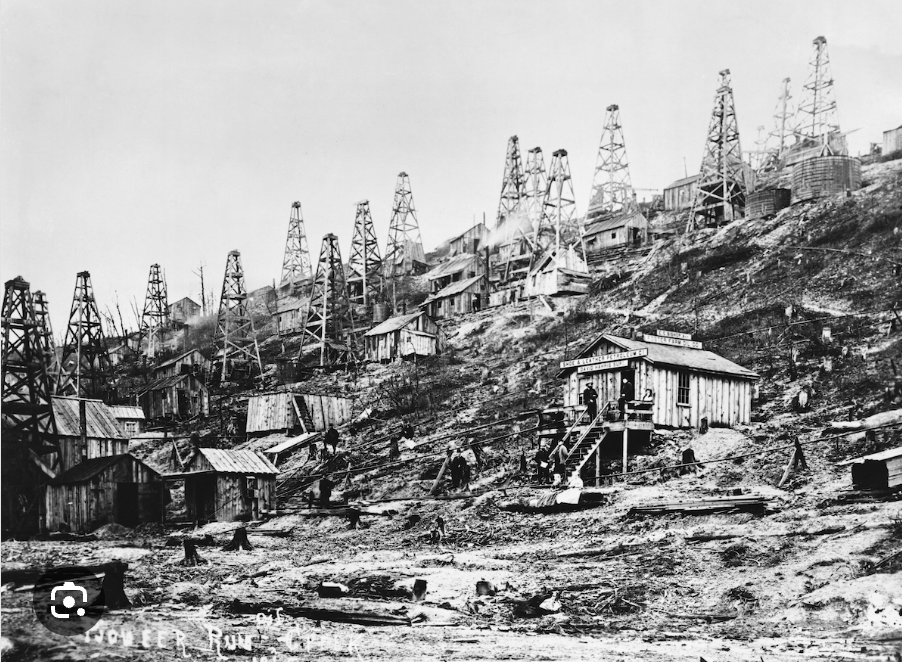

In addition, during the 1800s the Industrial Revolution led to the production of goods using a variety of raw materials, including oil, coal, iron, and cotton and wool. These raw materials were instrumental in the burgeoning U.S. manufacturing industry, used in the production of petroleum, steel, textiles (Lowell, Massachusetts’s mills were the first in the U.S. to use large-scale machinery and new methods of organizing workers to mass produce cloth), and energy production, along with mass production of new inventions like the sewing machine (1846) and photography equipment (1822), and refinement of prior inventions like the steam engine (e.g. pistons added) and glassmaking (e.g. synthetic glass, rolled glass, pressed glass).51 52 53 54 55 56 In support of industrialization, financial industries and communication also organized for these large scale enterprises (e.g. telegraph (1835), life insurance (first law allowing women to take out a life insurance policy on their husband was passed in New York in 1840; soon all the remaining states followed suit)).57 58
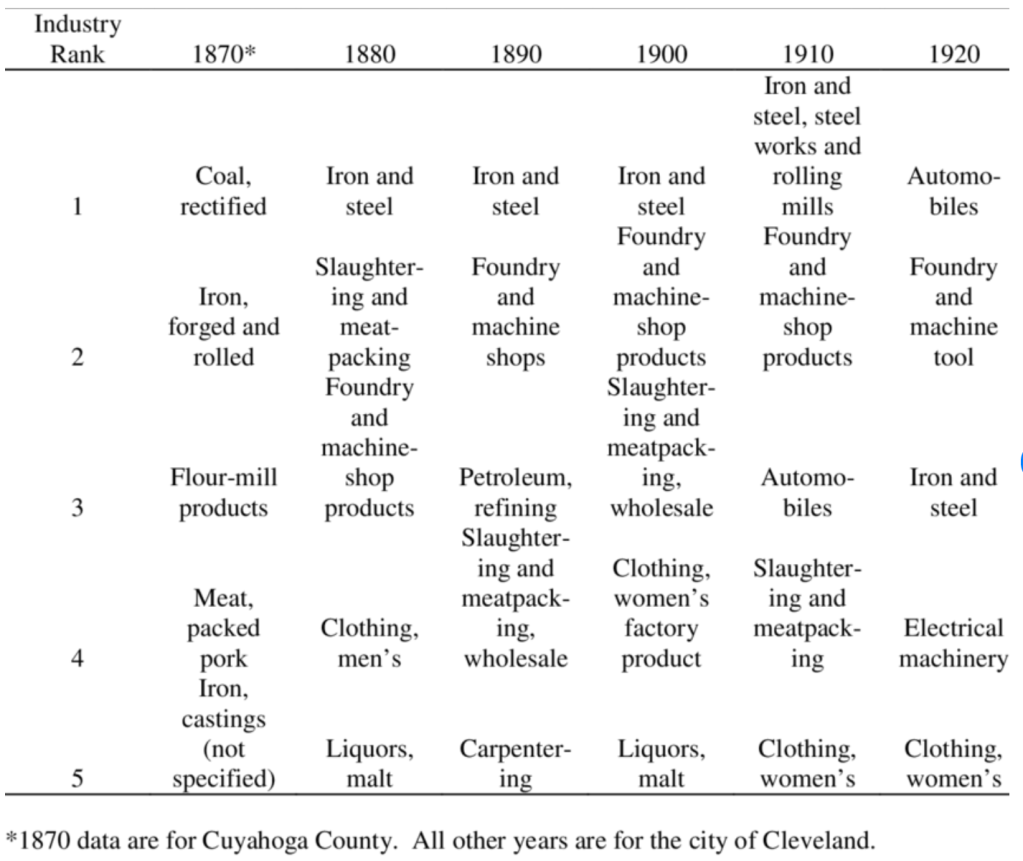
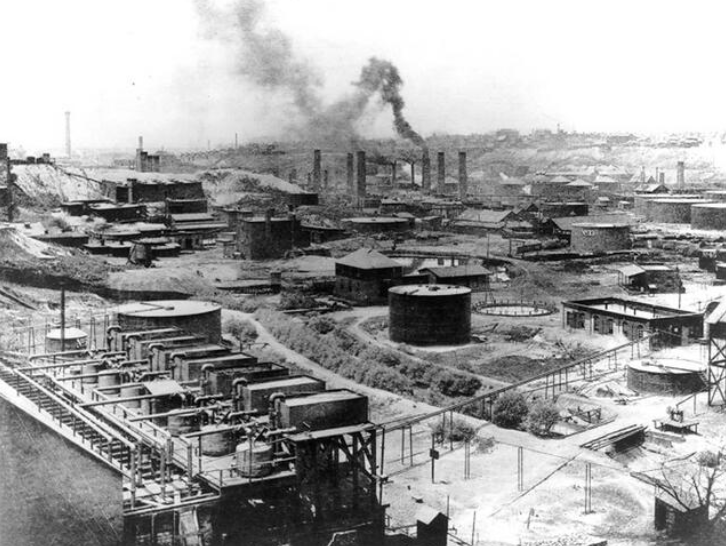
Aided by its proximity to rail and water routes and natural resources like coal and oil, Cleveland served as a central hub for industrial growth, commerce, and trade.59 “Cleveland’s history from 1860-1930 was mostly a record of heavy industrialization, not commerce in agricultural products. The Civil War gave immediate impetus to Cleveland’s iron industry, and by 1880 the making of iron and steel represented 20% of the value of the city’s manufactures...In part this growth was due to enterprising Clevelanders, who in the 1850s began exploiting the mineral resources of the upper Great Lakes and shipping the ores to Cleveland…The making of machinery and other iron and steel products, such as ore vessels for the Great Lakes trade, continued to grow, along with the production of iron and steel. Machine-tool companies… made lathes, planers, drill presses, and similar devices or parts for them. Sewing-machine manufacturers and other machinery companies were major purchasers of machine tools. In turn, the Cleveland clothing industry, already the city’s 3rd-largest producer of goods (by value) in 1860, became a major consumer of sewing machines. This industrial interconnection (iron and steel, machine tools, sewing machines, clothing) is one example of how growing industries benefited by linking to one another. Such interconnections were crucial to the development of Cleveland’s industries.“60



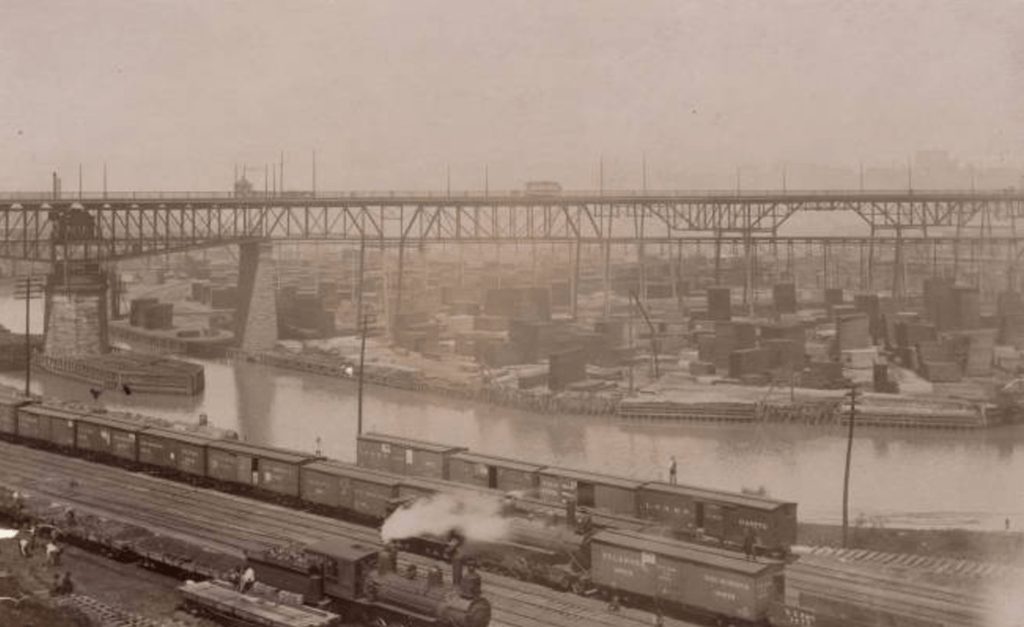

The same impacts and trends could be seen in the Taylor family’s endeavors through-out the 1800s. As mentioned above, Elisha partnered with a local real estate developer, James Madison Hoyt, under the name Taylor & Hoyt. Hoyt had a well-known law and real estate business, “On his own or with other investors, he subdivided and sold almost 1,000 acres of city and suburban land. He alone was responsible for opening and naming over 100 streets, developing neighborhoods on Prospect, St. Clair, Superior, and Kinsman avenues on the east side, and Madison Ave., Colgate, Lawn, and Waverly (W. 58th St.) on the west side. Known as the ‘honest lawyer,’ Hoyt’s reputation carried over to his real estate dealings.“61 Based on hundreds of Taylor & Hoyt land deeds and other court documents it is clear these lots readily sold to the many migrants and immigrants arriving in Cleveland.
In addition, Elisha purchased land in Lorain (100 acres) and Medina (1330 acres) counties in Ohio and also purchased land in Indianapolis, Indiana that he subdivided into individual lots with Hoyt.62 63 64 Given his real estate holdings in Cleveland alone Elisha estimated in the 1860 U.S. Census that his real estate was valued at $8 million (today’s dollars).65 Given Cleveland’s continuing growth and future prospects, Elisha was well-positioned to prosper financially.
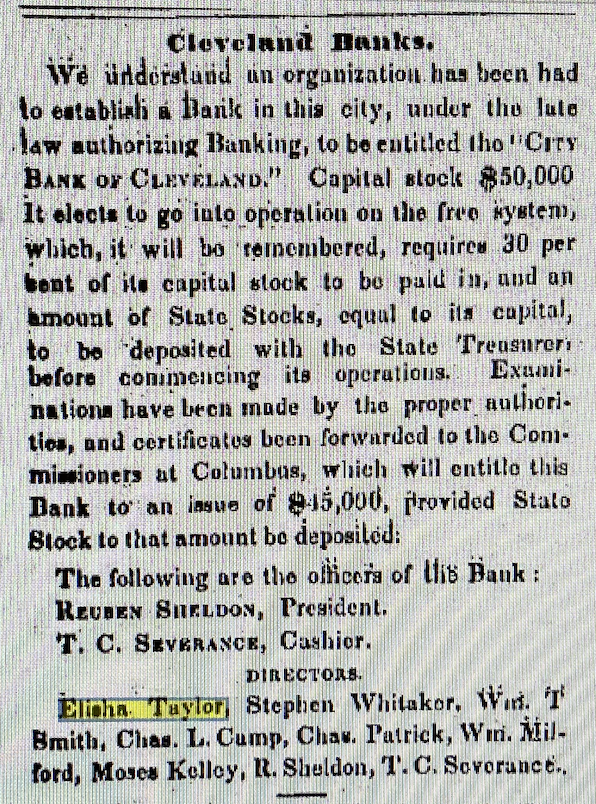
However, real estate was just one opportunity available to the Taylors in this rapidly evolving city and country. Elisha was involved in the City of Cleveland Bank where he was a Director and a Vice President (1845).66 “The first generation of Cleveland banks were formed prior to the Civil War when the city was no more than a frontier village. Most noteworthy of these were City Bank (1845), a commercial bank dealing primarily with businesses and business loans… In 1863, during the Civil War, the National Banking Act created a national banking system to fund the Civil War. One of the first banks in Cleveland to become a nationally chartered bank was City Bank in 1865, which issued its own bank notes until the 1920s.“67

In addition, Elisha was secretary in the Cleveland and Chagrin Falls Plank Road Company (1849).68 Plank roads had their heyday between 1840-1855, right when Elisha was actively involved, but then crashed because, “[t]he cost and difficulty of the maintenance coupled with improved road technology — not to mention the incredibly rough ride the planks created and the fact that the road was only wide enough for a single vehicle — meant that the days of the Plank Road were numbered.“69


Given the close-knit Taylor family background and education during the 1800s, their opportunity to influence Cleveland’s future direction and make money while doing so was incredible. There were huge challenges, too, from living in a rapidly growing frontier town, some of which the Taylors attempted to address, such as, intemperance and education. Nonetheless, they lived in a time of inordinate opportunity — which they effectively capitalized on.
Cleveland will never look the same to us. Given our unexpected stop at a Cleveland port we discovered that our ancestors played a meaningful role in a city we almost dismissed as a rustbelt casualty. We now see the city with fresh eyes. Eyes that see through some of her current retrenchment and can imagine the historic Cleveland superimposed on her today. Much to our surprise, the Cleveland and Taylor stories were highly intertwined. And, we would have likely never known had we not been forced to dock at the 55th East Street Marina for five days due to heavy weather.
© 2024 Elizabeth Scott Wright
- Elisha Taylor Alumni File, Union College Schaffer Library Digital Projects, 1810, https://arches.union.edu/search?search_api_fulltext=elisha+taylor&op=Search ↩︎
- Original Elisha and Elizabeth Ely Taylor Letter to Mary Goodwin, April 1826, Ancestry.com_link_to_Transcribed_Letter ↩︎
- Gertrude Van Rensselaer, The Pioneer Families of Cleveland
1796 – 1840, Evangelical Publishing House, 1916, pg. 169-170, https://ohiogenealogyexpress.com/cuyahoga/cuyahogaco_bios_1914/cuyahogaco_bios_1914_pg0166.htm ↩︎ - Ludlow, Arthur C., D.D., The Old Stone Church: The Story of a Hundred Years 1820-1920, The First Presbyterian Society in Cleveland (privately published), 1920, pg. 15 ↩︎
- Works Progress Administration in Ohio: District 4, Annals of Cleveland 1818-1835, Cleveland Newspaper Digest Jan. 1 to Dec. 31, 1825, Abstract 318, pg. 222 ↩︎
- Peet, Elijah, Cleveland & Ohio City Directory for the Years 1845-6, Sanford & Hayward Printers, Cleveland, 1845, pg. 139 ↩︎
- Peet, Elijah, Cleveland & Ohio City Directory for the Years 1845-6, Sanford & Hayward Printers, Cleveland, 1845, pg. 144 ↩︎
- Stapleton, Darwin H., Encyclopedia of Cleveland History, Case Western Reserve University, https://case.edu/ech/articles/i/industry#:~:text=In%20part%20this%20growth%20was,the%20Cleveland%20Rolling%20Mill%20Co. ↩︎
- Cleveland Population Change, 1800-2020, Visual Cleveland, CSU Center for Public History + Digital Humanities ↩︎
- Barrow, William C., Encyclopedia of Cleveland History, Case Western Reserve University, https://case.edu/ech/articles/r/real-estate ↩︎
- Orth, Samuel Peter, History of Cleveland, Ohio, S.J. Clarke Publishing Company, Cleveland, 1910, pg. 353 ↩︎
- Ludlow, Arthur C., D.D., The Old Stone Church: The Story of a Hundred Years 1820-1920, The First Presbyterian Society in Cleveland (privately published), 1920, pg. 15 ↩︎
- Ludlow, Arthur C., D.D., The Old Stone Church: The Story of a Hundred Years 1820-1920, The First Presbyterian Society in Cleveland (privately published), 1920, pg. 15 ↩︎
- Ludlow, Arthur C., D.D., The Old Stone Church: The Story of a Hundred Years 1820-1920, The First Presbyterian Society in Cleveland (privately published), 1920, pg. 16 ↩︎
- https://www.abebooks.com/paper-collectibles/Temperance-Recorder-Vol-Vol-Nos-6-9/31776711966/bd ↩︎
- Report of the Executive Committee of the American Temperance Union 1840, S.D. Benedict, New York, 1840, pg. 4 ↩︎
- Edwards, Justin, Letter to the Friends of Temperance in Massachusetts, Seth Bliss, and Perkins and Marvin, Boston, 1836, pg. 29, https://www.google.com/books/edition/Letter_to_the_Friends_of_Temperance_in_M/uOwDWf-dJygC?gbpv=1&bsq=%22Elisha%20Taylor%22 ↩︎
- Edwards, Justin, Letter to the Friends of Temperance in Massachusetts, Seth Bliss, and Perkins and Marvin, Boston, 1836, pg. 28-30, https://www.google.com/books/edition/Letter_to_the_Friends_of_Temperance_in_M/uOwDWf-dJygC?gbpv=1&bsq=%22Elisha%20Taylor%22 ↩︎
- Peet, Elijah, Peet’s General Business Directory of the Cities of Cleveland and Ohio for the Years 1845-46 Together with a Historical and Statistical Account, Sanford & Hayward Printers, Cleveland, 1846, pg. 116 ↩︎
- Peet, Elijah, Peet’s General Business Directory of the Cities of Cleveland and Ohio for the Years 1845-46 Together with a Historical and Statistical Account, Sanford & Hayward Printers, Cleveland, 1846, pg. 116 ↩︎
- Plain Dealer, Cleveland, 1840-1852 ↩︎
- Ward, Geoffrey C., Saxton, Martha, Gordon, Ann Dexter, DuBois, Ellen Carol, Not for Ourselves Alone, A.A. Knopf: Knopf Doubleday Publishing Group, 1999 ↩︎
- Nespor, Cassie, Melnick Medical (history) Museum, 2013, https://melnickmedicalmuseum.com/2013/10/08/drinking-patterns-in-america/ ↩︎
- Bootleggers and Gangsters: The Rise and Fall of Prohibition, https://capitolhistory.org/society-events/the-prohibition-amendments/?gad_source=1&gclid=CjwKCAiA3Na5BhAZEiwAzrfagFEnCTl0xYDDwEa7lYoFu1b1E-EiqAfPRnhAef5SAq0_Fr_RTuxmvRoCFYAQAvD_BwE ↩︎
- Scott-Hopkins Family Tree, Ancestry.com (by ancestor has details on individual occupations, education and source details) ↩︎
- History of the American Legal Profession, https://en.wikipedia.org/wiki/History_of_the_American_legal_profession ↩︎
- Journals of the Provincial Congress, Provincial Convention, Committee of Safety and Council of Safety of the state of New-York – 1775-1775-1777, Vol I and II, Thurlowweed Printer to the State, Albany NY, 1842 ↩︎
- Cox, Rev. Henry Miller, The Cox Family in America, The University of Wisconsin – Madison, 1912, pg. 163 ↩︎
- Cox, Rev. Henry Miller, The Cox Family in America, The University of Wisconsin – Madison, 1912, pg. 163 ↩︎
- Gooley, Lawrence P., John W. Taylor: New York’s (Almost Only) Speaker of the House, Adirondock Almanac, Jan. 3, 2019, https://www.adirondackalmanack.com/2019/01/john-w-taylor-new-yorks-almost-only-speaker-of-the-house.html ↩︎
- Major Richard Cox Original Member, Admitted 1783, The Society of the Cincinnati in the State of New Jersey, https://njcincinnati.org/richard-cox/#:~:text=Major%20Richard%20Cox&text=Began%20his%20service%20in%20the,NJ%20Line%201%20Jan%201781. ↩︎
- New York State Senate, Assembly Resolution N. 788 by M. of A. Norris, https://legislation.nysenate.gov/pdf/bills/2017/K788 ↩︎
- 1850 U.S. Federal Census, Syracuse Ward 2, Onondaga, New York, 1850, https://www.ancestry.com/imageviewer/collections/8054/images/4202537_00128?pId=7832068 ↩︎
- Decisions Relating to Pensions, U.S., Department of the Interior Decisions on Pensions and Bounty-Land Claims, 1886-1930, Volume 10 1898-1900, pg. 188 ↩︎
- J. Taylor Alumni File, Union College: Arches, https://arches.union.edu/do/67ccd028-f99a-45fc-a15e-eb1939a78ef4 ↩︎
- Carlisle, Fred.. Chronography of notable events in the history of the Northwest Territory and Wayne County : period embraced, 1531-1890 : together with biographical sketches of the early explorers and pioneers. Detroit: O.S. Gulley, Bornman & Co., printers, 1890, pg 362-4 ↩︎
- Taylor Family Papers, 1785-1897, Saratoga County Historical Society, https://brookside.pastperfectonline.com/archive/56FE9827-87DE-431A-9684-947033671558 ↩︎
- 1860 U.S. Federal Census, Cleveland Ward 4, Cuyahoga, Ohio, 1860, https://www.ancestry.com/imageviewer/collections/7667/images/4282498_00476?pId=42831966 ↩︎
- U.S. School Catalogs 1765-1935, New York, Vassar Female College, 1869, https://www.ancestry.com/imageviewer/collections/2203/images/32761_2221301230_6604-00023?pId=4177974 ↩︎
- Wilson, James Grant and Fiske, John (editors), Appletons’ Enyclopedia of American Biography, 1600-1889, Vol. VI Sunderland-Zurita, D. Appleton and Company, New York, 1889, pg. 46 ↩︎
- 1850 U.S. Federal Census, Cleveland Ward 1, Cuyahoga, Ohio, 1850, https://www.ancestry.com/imageviewer/collections/8054/images/4191061-00133?pId=13433362 ↩︎
- Lewis and Clark Expedition, Wikipedia: the Free Encyclopedia, https://en.wikipedia.org/wiki/Lewis_and_Clark_Expedition ↩︎
- Destination America: U.S. Immigration, When Did They Come?, https://www.pbs.org/destinationamerica/usim_wn_noflash_2.html ↩︎
- The Rise of American Industry, U.S. History: Pre-Columbian to New Millennium, https://www.ushistory.org/us/25f.asp#:~:text=From%201820%20to%201870%2C%20over,almost%20a%20third%20from%20Germany. ↩︎
- The Beginnings of American Railroads and Mapping, Library of Congress, https://www.loc.gov/collections/railroad-maps-1828-to-1900/articles-and-essays/history-of-railroads-and-maps/the-beginnings-of-american-railroads-and-mapping/ ↩︎
- A National Treasure, Erie Canalway National Heritage Corridor, https://eriecanalway.org/learn/history-culture ↩︎
- The Canal-Era History of the Ohio & Erie Canalway, Ohio & Erie Canalway, https://www.ohioanderiecanalway.com/learn/canalway-history/ ↩︎
- Lang, William L., Oregon Trail, Oregon Encyclopedia: A Project of the Oregon Historical Society, https://www.oregonencyclopedia.org/articles/oregon_trail/#:~:text=The%20Oregon%20Trail%20has%20attracted,%2C%20Utah%2C%20and%20California%20destinations. ↩︎
- Plank Roads, Wikipedia, https://en.wikipedia.org/wiki/Plank_road#:~:text=in%20Roman%20times.-,In%20North%20America,which%20had%20copied%20Russian%20ones. ↩︎
- The Rise of the Steam Engine, National Coal Mining Museum, https://www.ncm.org.uk/news/the-rise-of-the-steam-engine/ ↩︎
- The Mill Girls of Lowell, National Park Service, https://www.nps.gov/lowe/learn/historyculture/the-mill-girls-of-lowell.htm#:~:text=Beginning%20in%201823%2C%20with%20the,a%20measure%20of%20economic%20independence. ↩︎
- How Has Energy Use Changed Throughout U.S. History?, U.S. Energy Information Administration, July 3, 2024, https://www.eia.gov/todayinenergy/detail.php?id=62444 ↩︎
- Stamp, Jimmy, The Many, Many Designs of the Sewing Machine, The Smithsonian Magazine, October 16, 2023, https://www.smithsonianmag.com/arts-culture/the-many-many-designs-of-the-sewing-machine-2142740/ ↩︎
- History of Photography: The Wizard of Photography Timeline, PBS, https://www.pbs.org/wgbh/americanexperience/features/eastman-history-photography/ ↩︎
- Lira, Carl, Brief History of the Steam Engine, Michigan State University, https://www.egr.msu.edu/~lira/supp/steam/ ↩︎
- Miller, George L. History of the Franklin Glass Works Portage County, Ohio, Colonial Williamsburg Foundation, Williamsburg, Virginia, Summer 2004, https://www.fohbc.org/PDF_Files/FranklinGlassWorks.pdf ↩︎
- 1830s – 1860s: Telegraph, Elon University: Imagining the Internet, a History and Forecast, https://www.elon.edu/u/imagining/time-capsule/150-years/back-1830-1860/#:~:text=The%20Development%20of%20the%20Telegraph&text=New%20York%20University%20professor%20Samuel,concept%20to%20the%20U.S.%20Congress. ↩︎
- The Interesting History of Life Insurance, TruStage, February 6, 2020, https://www.trustage.com/learn/life-insurance/life-insurance-history ↩︎
- Cleveland’s Largest Industries from 1870-1920, ResearchGate, https://www.researchgate.net/figure/CLEVELANDS-LARGEST-INDUSTRIES-1870-1920_tbl2_5185605 ↩︎
- Industry, Encyclopedia of Cleveland History, Case Western Reserve University, https://case.edu/ech/articles/i/industry#:~:text=With%20the%20coming%20of%20the,large%20flour%20mill%20under%20construction. ↩︎
- Hoyt, James Madison, Encyclopedia of Cleveland History, Case Western Reserve University, Cleveland, https://case.edu/ech/articles/h/hoyt-james-madison ↩︎
- Lorain County Record of Deed, FamilySearch, https://www.familysearch.org/ark:/61903/3:1:3QS7-9965-QXYR?view=fullText&keywords=Elisha%20Taylor%2CUnited%20States%2CLorain%2COhio%2Cdeed&groupId=TH-1951-39424-12918-45 ↩︎
- Medina County Record of Deed, FamilySearch, Film # 007901175, https://www.familysearch.org/ark:/61903/3:1:3Q9M-CS4Y-WQT1?i=318&cat=1087 ↩︎
- 1860 U.S. Federal Census, Cleveland Ward 4, Cuyahoga, Ohio, https://www.ancestry.com/imageviewer/collections/7667/images/4282498_00476?pId=42831964 ↩︎
- Johnson, Crisfield, The History of Cuyahoga County Ohio: Part 1, D.W. Ensign & Co., Cleveland Ohio, 1879, pg. 298 ↩︎
- Banking, Encyclopedia of Cleveland History, Case Western Reserve University, https://case.edu/ech/articles/b/banking ↩︎
- To Plank Road Contractors, Plain Dealer Newspaper, April 17, 1849, pg. 3 ↩︎
- Toll Roads, Encyclopedia of Cleveland History, Case Western Reserve University, https://case.edu/ech/articles/t/toll-roads ↩︎
- Plank Road Boom https://en.wikipedia.org/wiki/Plank_Road_Boo
m ↩︎
 The Boating Genealogists
Wonderful account describing you Cleveland, Ohio family history! Thank you! Ann
LikeLike