1692 – Susannah Roots and the Salem Witch Trials
Josiah Root was born in 1612. His wife Susannah and he lived in Beverly MA on the outskirts of Salem MA. Josiah died in 1683. After his death his widow Susannah was caught up in the Salem Witch trials of 1692.
Cotton Mather wrote a defense of the Salem Witch Hunt of 1692 called Wonders of the Invisible World. Mather was about 30 years old when the trials took place and when he wrote the book. In that book he begins his stream of logic with the statement that there is a devil and anyone who denies that is a devil.[1]
Mather blamed the hardships of settling New England squarely on the devil. He stated there are many agents of the devil, stating that witches are such agents. According to him, bad things, like bad weather, bad crops, Indian attacks, and plagues were all the fault of the devil.[2]
Mather tells us that the rules for discovery of witches, and the rationales used to question accusers and the accused for the purpose of determining a witch in a witch trial, are given in three guides. Rationales and rules provided in those guides lean heavily on superstition and lightly on reason:
- An Abstract of Mr. Perkins’s Way for the Discovery of Witches. [3]
- Mr. Gaules, Judgment about the Detection of Witches. [4]
- Bernard of Batcomb’s, Guide to Grand Jury men. [5]
Mather says he was not at the Salem Witchcraft trials.[6] Rather, he was in possession of materials from the trials from which he recounts in his book the trial details of five of those executed in 1692.[7] Reading Mather’s account of the testimony at the trials of the accused, the wild accusations made, the preposterous leap of faith required to even begin to believe any of the things said, it becomes obvious that the accusers lied or were mentally unbalanced.
Much weight was given to accusations made by accusers when made under oath. Their wild statements were accepted as truth. There was no order in the court. Ghastly in-court outbursts by accusers were common and used as proof of the witchcraft charges. There was no sequestration of witnesses to eliminate testimony collusion among accusers. Those accused were expected to either confess, or to deny being a witch.
If the accused confessed and implicated others, she was likely to escape with her life. If the accused fought the charge and denied that she was a witch then it became likely that she was a witch. If the accused ridiculed the charges or their accusers it prompted additional frightening in-court outbursts by their accusers that then became more proof of the accused’s supposed guilt.
The motivations for the accusers’ lies and deceptions have been debated over time and are lost in obscurity, only to be guessed at. It is likely there were multiple reasons. Throwing suspicion on others, confessing in order to escape a death sentence, confessing to obtain favorable treatment while jailed, obtaining the property of others through guile, and revenge for past disagreements are some of the reasons surmised by historians. Other reasons proposed are mental problems due to the tremendous stresses of the Indian Wars that raged during these times, or accidental ingestion of psychotropic substances such as rye mold. This was the state of affairs in and around Salem Massachusetts when the warrant for the arrest of Susannah Roots was issued May21, 1692.
On May 23rd 1692 Andrew Elliott stated that another man named Leonard Austen said that Susannah Roots did not go to church, Andrew Elliott also said that he heard Susannah and others talking in her room, the room below his, as she flew about the room. Other accusers, Mary Wallcott, Abigal Williams, Marcy Lewis, Ann Puttnam, and others accused Susannah of “sundry acts of witchcraft upon their bodys.” Susannah’s arrest warrant and the statements against her appear below.
Warrant for the Apprehension of Susannah Roots, and Officer’s Return
Salem May 21, 1692
To the Constables of Beverly.
Whereas Complaint hath been this day made before us, by Sergent Thomas Puttnam and John Puttnam: both of Salem village yeomen against Susannah Roots of Beverly widdow for Sundry acts of witchcrafft by her Commited on the bodys of Mary Wallcott Abigal Williams Marcy Lewis Ann Puttnam and others.
You are therfore in their Majesties names hereby Required to apprehend and forthwith bring before us Susannah Roots of Beverly widdow, who stands charged with Committing Sundry acts of witchcraft as above s’d to the wrong and Injury of the bodys of the abovenamed persons, in order to her Examination Relateing to the above s’d premises faile not. Dated Salem May the 21’st 1692
( Essex County Court Archives, Salem — Witchcraft Vol. 1, no. 305 ) [8]
Susannah Roots Arrest Warrant

Statement of Andrew Elliott v. Susannah Roots
May 23, 1692
An information if it might be any help in the Examination of the person before you goode Roots I being in the house of m’r Laurence Dennis some time since she was suspected for what shee is now before you & there was Likewise Leonard Austen of ou’r Town of Beverly s’d Austen then s’d that he thought she was a bad woman, his reason was that he Living in the house with s’d Roots not Long since and when he went to prayer at any time with his wife & thought sd Roots would acompany them in s’d Duty but Did not at any time but would withdraw & absent her selfe: & further when my self and wife were gone to bed & she unto her bed. she would rise in the night & we Could here her talk in the roome below flying in the Chamber over s’d roome as if there there were: 5 or six persons with her more s’d Austen might speak if Caled thereunto as far as know more Concering Roots.
(Essex County Court Archives, Salem — Witchcraft Vol. 1, no. 306 ) [9]
Andrew Elliott’s Statement against Susannah Roots

Cotton Mather provides us an insight into the reasoning for stopping the lunacy of the witch hunt. The numbers of new accusations grew as people being charged with witchcraft sought to incriminate others in order to escape or mollify the charges against themselves. It was recognized there was no concrete proof of the endless stream of accusations and there was no adequate defense against spectral evidence. People who had led blameless lives were being pulled into the maelstrom of growing accusations. It was also recognized that similar mistakes made in the past in Europe were being repeated, and that the number of those accused would soon encompass an entire generation of people. Cotton Mather said,
By these things you may see how this matter was carry’d on, viz: chiefly by the complaints and accusations of the afflicted (bewitch’d ones, as it was suppos’d) and then by the confessions of the accus’d, condemning themselves and others. Yet experience shew’d that the more there were apprehended, the more were still afflicted by Satan; and the number of confessors increasing, did but increase the number of the accused; and the executing of some, made way for the apprehending of others: For still the afflicted complain’d of being tormented by new objects, as the former were remov’d. So that those that were concern’d, grew amaz’d at the number and quality of the persons accus’d, and feared that Satan by his wiles had enwrapped innocent persons under the imputation of that crime. And at last it was evidently seen that there must be a stop put, or the generation of the children of God would fall under that condemnation.
Henceforth, therefore, the juries generally acquitted such as were tried, fearing they had gone too far before. And Sir William Phips, the Governor, repriev’d all that were condemn’d, even the confessors as well as others. And the confessors generally fell off from their confession, some saying, “They remembered nothing of what they had said;” others said, “They had belied themselves and others “Some broke prison and ran away, and were not strictly searched after. Some acquitted, some dismissed, and, one way or other, all that had been accused were set or left at liberty. And, altho’ (had the times been calm) the condition of the confessors might have called for a Melius inquirendum, (closer investigation), yet, considering the combustion and confusion this matter had brought us unto, it was thought safer to under-do than over-do, especially in matters capital, where what is once compleated cannot be retrieved; but what is left at one time, may be corrected at another, upon a review and clearer discovery of the state of the case. Thus this matter issued somewhat abruptly.[10]
Mather went on to consider more specifically the reasons for why the Salem troubles were finally quelled:
It may be queried, How doth it appear that there was a going far in this affair?
1. By the numbers of the persons accus’d, which at length increas’d about an hundred; and it cannot be imagin’d that in a place of so much knowledge, so many in so small a compass of land, should so abominably leap into the devil’s lap all at once.
2. The quality of several of the accus’d was such as did “bespeak better and things that accompany salvation;” persons, whose blameless holy lives before did testifie for them; persons that had taken great pains to bring up their children in the nurture and admonition of the Lord; such as we had charity for, as for our own souls: and charity is a Christian duty commended to us.
3. The number of the afflicted daily increased, until about fifty persons were thus vex’d by the devil. This gave just ground to suspect some mistake, which gave advantage to the “accuser of the brethren” to make breach upon us.
4. It was considerable that nineteen were executed, and all denied the crime to the death, and some of them were knowing persons, and had this been accounted blameless livers. And it is not to be imagin’d but that, if all had been guilty, some would have had so much tenderness to seek mercy for their souls, in the way of confession and sorrow for a sin. And as for the “condemn’d confessors” at the bar (they being repriev’d) we had no experience whether they would stand to their self-condemning confessions when they came to die.
5. When this prosecution ceas’d the Lord so “chain’d up Satan” that afflicted grew presently well: the accused are generally quiet; and for five years since we have no such molestation by them.
6. It sways much with me, which I have since heard and read, of the mistakes in other places. As in Suffolk in England about the year 1645, was such a prosecution, until they saw, that unless they put a stop, it would bring all into blood and confusion…[11]
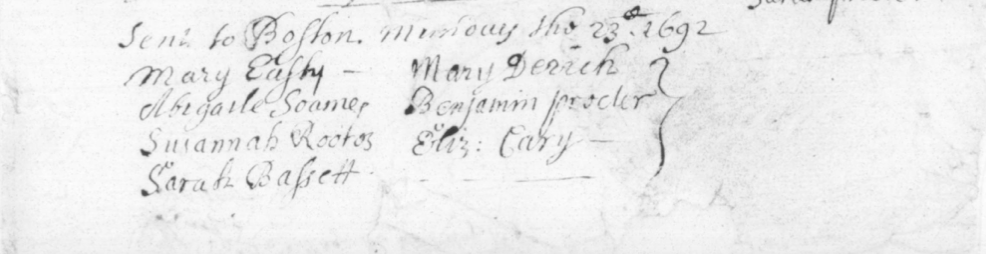
Susannah Roots was sent to prison in Boston on May 23rd 1692 along with several others (see image below).[12] The jail was a very unhealthy place. At least four of the accused died while imprisoned there.[13] There is no record of her trial nor is there a record of her death.[14] My ancestor Susannah Roots disappears from history at this point, a casualty of the misguided, and never to be forgotten, Salem Witch Trials. Her descendants include several Revolutionary War soldiers. Some of her descendants relocated from Salem to Woodbury CT and then into New York and later to the Midwest of the U.S. and beyond.
Susannah Roots Sent to Boston’s Jail May 23rd 1692
.
[1] Cotton Mather, Wonders of the Invisible World, p. 42, Boston, October 1692. Reprint Russell Smith, London, 1862. https://www.google.com/books/edition/The_Wonders_of_the_Invisible_World/7wsMAAAAIAAJ?hl=en&gbpv=1&bsq=witch
[2] Cotton Mather, Wonders of the Invisible World, p. 74-75, Boston, October 1692. Reprint Russell Smith, London, 1862.
[3] Cotton Mather, Wonders of the Invisible World, An Abstract of Mr. Perkins’s Way for the Discovery of Witches, p. 30-33,
[4] Cotton Mather, Wonders of the Invisible World, Mr. Gaules, Judgment About the Detection of Witches, p. 33-34.
[5] Cotton Mather, Wonders of the Invisible World, Rules from Bernard of Batcomb’s Guide to GrandJurymen, p. 35-36.
[6] Cotton Mather, Wonders of the Invisible World, p. 109, Boston, October 1692. Reprint Russell Smith, London, 1862.
[7] Cotton Mather, Wonders of the Invisible World, p. 120-159, Boston, October 1692. Reprint Russell Smith, London, 1862.
[8] https://salem.lib.virginia.edu/n116.html
[9] https://salem.lib.virginia.edu/n116.html
[10] Cotton Mather, D.D. F. R. S., Magnalia Christi Americana; Or, The Ecclesiastical History of New England, v. 2, p. 475-476, London, 1702. ReprintSilus Andrus and Son, Hartford, 1853. Retrieved from https://www.google.com/books/edition/_/iCxKAQAAMAAJ?hl=en&gbpv=1 Last accessed June 21, 2023.
[11] Id. at p. 476-477.
[12] Census of Prisoners and Date of Prison Transfers. https://salem.lib.virginia.edu/n166.html Last accessed July 4th 2023.
[13] Id.
[14] James Pierce Root, Root Genealogical Records, 1600-1870 : comprising the general history of the Root and Roots families in America, p. 52-53, R.C. Root, Anthony & Co., New York, 1870. https://www.google.com/books/edition/Root_Genealogical_Records_1600_1870/X6VPAAAAMAAJ?hl=en&gbpv=1 Last accessed July 2, 2023.
 The Boating Genealogists